The global digital information environment has officially transitioned from a retrieval-based economy to a synthesis-based ecosystem. For over two decades, the primary interface between a brand and its customer was the search results page—a list of blue links requiring human intervention to click, evaluate, and consolidate. As we move through 2026, this paradigm has been fundamentally restructured by AI-mediated discovery, a phenomenon described by McKinsey as a total reconfiguration of online visibility.
⚠️ The Global Visibility Crisis
Traditional Search Volume
Gartner 2026 forecast
Zero-Click Searches
Users never visit your site
International Pipeline Risk
For non-optimized multilingual sites
For a multilingual brand, this creates a "Visibility Crisis": if your localized content isn't "machine-readable" for the Large Language Models (LLMs) that now generate these answers, your international pipeline is at an immediate 20% to 50% risk.
For Chief Marketing Officers (CMOs) and founders, the data is sobering. Gartner estimates a 25% decline in traditional search volume as users migrate toward "substitute answer engines" like ChatGPT, Perplexity, and Google's Gemini-powered AI Overviews. We are witnessing the rise of the "Zero-Click" economy, where 58.5% of searches now end without a user ever visiting a source website.
To survive this "Traffic Apocalypse," brands must move beyond Multilingual SEO and master Multilingual Generative Engine Optimization (GEO). This is not just a technical update; it is a fundamental shift from "ranking for keywords" to "being the definitive authority on topics."
From Rankings to Authority
In the era of Generative Engine Optimization (GEO), your content must establish verifiable authority across every language. Learn the complete strategy in our comprehensive GEO Guide.
Defining the Core Entities: The Architecture of AI Discovery
To optimize for the generative web, we must first understand that AI models do not "index" pages like legacy crawlers; they parse entities and their relationships.
What is an Entity?
In the context of GEO, an Entity is a clearly defined person, organization, concept, or product that an AI model can recognize and reference with 100% confidence. This represents the shift from "strings to things." AI engines do not search for strings of text; they query their Knowledge Graph to see if your brand is a verified authority.
What is Schema Markup?
Schema Markup is a standardized format of metadata—typically written in JSON-LD—that provides machines with explicit instructions about your content. Schema acts as a "nutrition label" for your data, telling an AI exactly what is a price, an author credential, or a product benefit. Without advanced schema, your authority fails to translate. Use our Multilingual Schema Markup Guide to ensure your code matches your content in every language.
"In the age of generative AI, visibility is no longer a competition for position; it is a competition for certainty. The AI will only cite the sources it can verify with total confidence."
Phase 1: The Technical Infrastructure of Machine Discovery
Traditional search bots were designed for scalability over deep understanding. They cataloged pages based on keyword frequency and link structures. In contrast, AI crawlers like OpenAI's OAI-SearchBot or PerplexityBot are targeted and context-aware. They utilize Retrieval-Augmented Generation (RAG), where specific passages of a website are pulled and fed into the LLM as context to generate an answer with live citations.
🚨 Bridging the JavaScript Rendering Gap
A critical vulnerability in global websites is the inability of many AI crawlers to execute complex JavaScript. While Googlebot has a sophisticated rendering pipeline, many newer AI agents remain primitive. If your website relies on client-side rendering (CSR), an AI crawler fetches the initial HTML and receives only an empty shell—rendering your expensive translations invisible to the model.
The Fix: Server-Side Rendering (SSR) or Static Site Generation (SSG)
Ensure that your "Answer Nuggets"—the key facts and specifications—are present in the initial HTML payload. This is non-negotiable. For a deep dive into fixing these "blind spots," check out our AI SEO Vulnerability Detector tool.
⚡ Token Efficiency: The New Crawl Budget
In the SEO era, we managed crawl budgets. In the GEO era, we manage Token Efficiency. LLMs process information in "tokens" (roughly 0.75 words per unit), and every token consumed incurs a computational cost for the AI provider. Consequently, AI crawlers are inherently biased toward formats that provide the highest "Fact Density" with the lowest token tax.
The Markdown Advantage
Traditional HTML is "noisy," filled with navigation menus and tracking pixels. Converting a standard HTML page to Markdown (.md) can reduce token usage by 80-95% while preserving 100% of the semantic value.
This is a core pillar of our LLM Optimization strategy.
Phase 2: Multilingual Semantic Strategy and the Threat of "Semantic Collapse"
For global organizations, 2026 has introduced a complex retrieval risk known as Semantic Collapse. This occurs when AI models normalize multilingual content into shared numerical representations, treating translated pages as redundant.
The Mechanics of Redundancy
When an AI search engine processes a query, it employs a mechanism called "Query Fan-out," expanding the initial prompt into multiple sub-queries. If two pages—for instance, an English page and a Japanese translation—answer the same intent without substantive differentiation, the retrieval system recognizes them as interchangeable. During synthesis, the model will typically select the "strongest" version (frequently the English version due to training data bias) and ignore the localized alternative.
The Solution: Semantic Differentiation
Move beyond literal translation. To prevent semantic collapse, you must create substantive differentiation across language versions.
1. Inject Local Entities
Incorporate references to regional authorities, local landmarks, and market-specific regulations. A technical guide citing local "VAT-inclusive pricing" is semantically distinct from a global dollar-based equivalent.
2. Structural Variation
Prioritize different information based on local cultural values. For instance, emphasize "Reliability and Durability" for the German market while focusing on "Innovation and Style" for the US.
3. Cross-Lingual Entity Mapping
Use stable public identifiers, such as Wikidata Q-IDs, to help AI systems resolve who your regional variants are without ambiguity. Read more in our Keywords to Entities AI Search Optimization roadmap.
Phase 3: Optimizing for the "Citation Economy"
In 2026, the target outcome is no longer simply traffic; it is Answer Share. According to research, being cited in an AI Overview increases organic CTR by 35% compared to not being cited.
The Answer-First Content Architecture
To win the citation, your content must be "synthesis-worthy." AI models favor an "inverted pyramid" structure:
1. The Direct Answer (First 60-80 words)
State the conclusion or definition immediately following the header.
2. Supporting Evidence
Use HTML tables and bulleted lists. AI models are "fact-hungry" and ingest structured data 40% faster than dense paragraphs.
3. Information Gain
AI systems are programmed to ignore "slop." If your article says the same thing as the top five results, the AI will ignore you. Every page must include unique data, original frameworks, or first-person case studies.
Implementing the llms.txt Protocol
The llms.txt file is the new "tour guide" for machines. It is a lightweight Markdown file hosted in your root directory that explicitly prioritizes your most authoritative pages for AI models.
Generate Your llms.txt File
By using the MultiLipi llms.txt Generator, you can guide bots from OpenAI and Anthropic directly to your highest-value content, ensuring your brand POV is what gets cited. Learn more in our llms.txt Guide.
Phase 4: Measuring Success with "Share of Model" (SoM)
As traditional click-through rates become less reliable, the industry has shifted toward Share of Model (SoM) as the primary KPI.
📊 Key Share of Model Metrics
Mention Frequency
How often your brand name appears in AI responses.
📈 Measures overall awareness
Citation Share
% of AI responses that link to your domain.
🔐 Measures technical trust
Sentiment Polarity
Whether AI describes you as a "leader" or "legacy."
⭐ Measures brand reputation
Answer Share
The combined frequency of appearance vs. competitors.
🎯 The new market share
Unlike traditional rankings, SoM is probabilistic. An LLM may mention a brand in 80% of responses for "best CRM," but only 40% for "best CRM for startups." The goal is to increase that probability through continuous semantic refinement.
The MultiLipi Solution: 10-Minute Integration for Global Dominance
Managing the complexities of GEO, RAG retrieval windows, and cross-script entity mapping is a daunting task for even the most well-resourced marketing teams. This is why we built MultiLipi—not as a simple translation plugin, but as a comprehensive Multilingual GEO Orchestration Layer.
"While traditional translation agencies take months to deliver and legacy plugins like Weglot only focus on 'blue links,' MultiLipi transforms your global digital footprint in under 10 minutes."
How Our Automated GEO Integration Works:
Instant Infrastructure
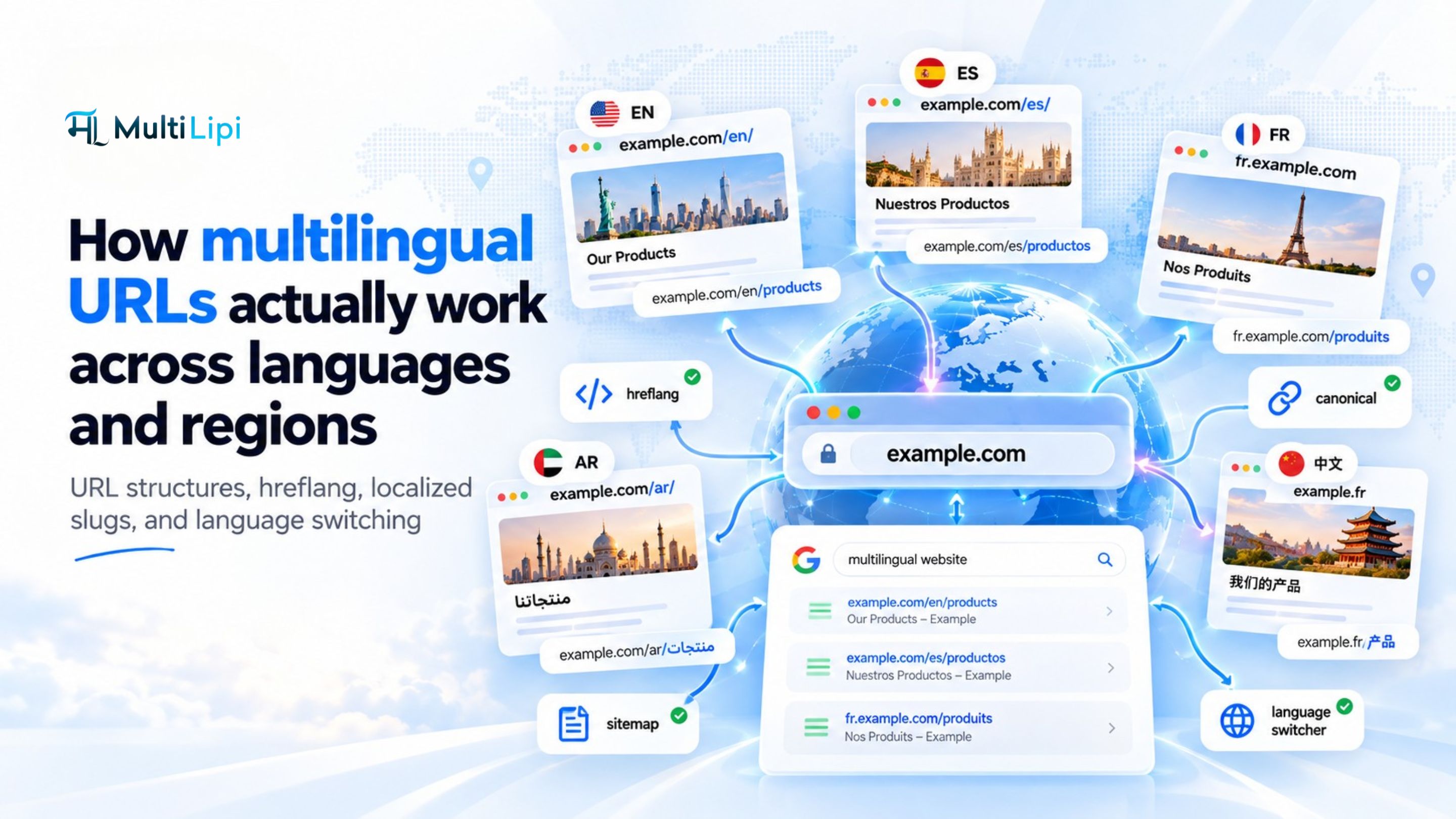
Our 10-minute integration automatically configures your subdirectory structure (e.g., /ja/, /de/) to retain root domain authority—a critical factor for trust signals. Learn more about our Technology.
Automated "AI Twin" Generation
For every page on your site, MultiLipi automatically generates a parallel, structured Markdown (.md) version. We serve these "Twins" directly to AI crawlers through content negotiation, slashing your token usage by up to 95% and ensuring your ingestion capacity is maximized.
Context-Aware Entity Mapping
We don't just swap words. Our engine identifies your core brand entities and localizes their attributes. We map your credentials to regional equivalents (e.g., mapping a US degree to a Japanese Gakushi) and inject localized schema properties like areaServed and priceCurrency automatically.
Dynamic Hreflang & SEO Injection
MultiLipi resolves the "technical debt" of international SEO by automatically injecting bidirectional hreflang tags and contextually translated URL slugs. You can verify this instantly with our AI SEO Vulnerability Detector.
LLMS.txt Automation
Our platform generates and maintains your llms.txt and llms-full.txt files, acting as a direct feed for the "agent swarm."
"MultiLipi isn't just about translating for humans; it's about building the infrastructure for the machines that now drive 44% of all consumer discovery."
Start Your 14-Day Free TrialConclusion: Securing the "New Front Door" to the Internet
The shift to AI search is not a peripheral marketing trend; it is a structural rewiring of the digital economy. Research suggests that the competitive divide in 2026 will not be between those who have content and those who don't—it will be between those who are machine-trusted and those who are invisible.
The "Cost of Invisibility" is no longer a theoretical risk. If an AI agent cannot verify your brand's expertise in a local market, you are excluded from the purchase journey before it even begins.
Turn the "Traffic Apocalypse" into Your Competitive Advantage
Stop losing your hard-earned traffic to AI. With MultiLipi, you can transition your entire global site from legacy SEO to advanced GEO in the time it takes to have a coffee.