Introduction
Every few months, someone declares search engine optimization dead. Then AI assistants arrive, and the debate starts again: do you need a whole new discipline called generative engine optimization?
The short answer is no. GEO builds on SEO rather than replacing it, because ChatGPT, Perplexity, and Google AI Overviews all draw from the same web that search engines crawl, index, and rank.
That shared foundation changes how you should plan. Your existing SEO work is not wasted, but it is no longer the whole job.
Why the replacement question keeps coming up
Every time search changes, someone declares SEO dead. AI answers have made that claim louder.
When ChatGPT, Perplexity, and Google's AI Overviews respond directly, the ranked list of links can look like it is fading. So people ask whether generative engine optimization (GEO) replaces search engine optimization (SEO).
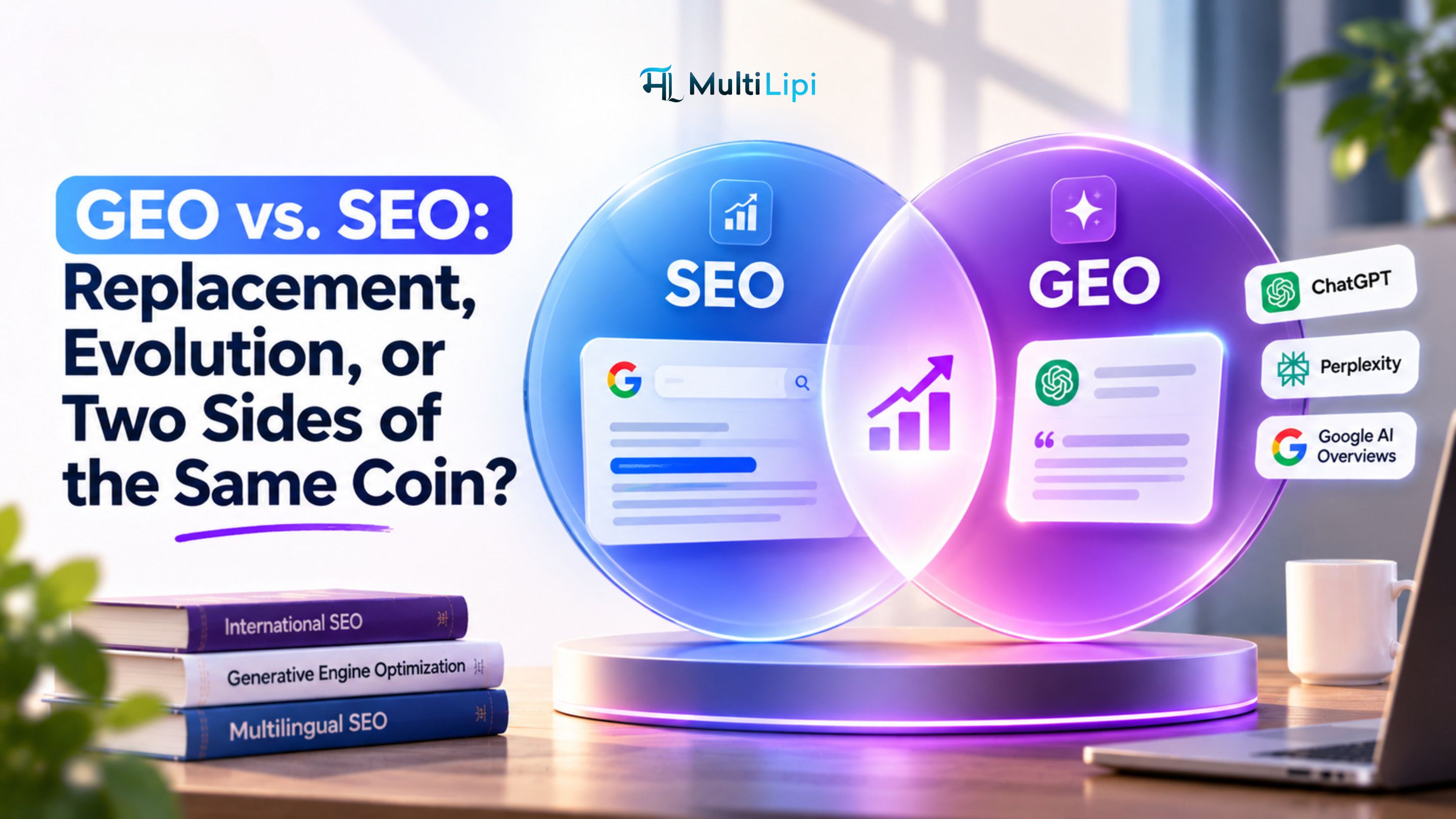
It does not. GEO extends SEO. SEO helps you rank in search results, while GEO helps your brand get mentioned, cited, and accurately represented in AI-generated answers.
Where AI answers actually get their information
AI engines do not work from a separate internet. They find, understand, and reference digital content that already exists on the open web.
That shared source is why the two disciplines are tied together:
- Strong SEO gives you a head start in AI answers.
- Ranking alone does not guarantee a citation.
- Content structure decides whether AI tools can use your pages.
The rest of the comparison follows from that foundation.
What SEO and GEO Each Aim to Achieve
A page earns a place in a list of ranked results. A person chooses whether to visit.
Measure → rankings · clicks · visitsYour content informs a generated response, which may mention or cite the brand directly.
Measure → citations · mentions · share of voiceThese are illustrative interfaces, not live Google or AI-platform results.
The two disciplines share a strategic foundation. What differs is what counts as a win and who you are trying to reach.
SEO: earning rankings and clicks
SEO aims to get your pages ranked in results on Google and Bing. The reward is a click from a person scanning a list of links.
That goal shapes how you measure progress. SEO tracks:
- Rankings for target queries
- Clicks from search results
- Traffic to your site
Traditional search still generates the majority of organic web traffic. That keeps SEO central to any visibility plan.
GEO: earning mentions and citations in AI answers
GEO aims to get your brand into the answer itself. The audience is someone asking ChatGPT, Perplexity, or Google's AI Overviews a question and reading the response.
Visibility here is about representation, not just position. You want to be found, cited, and trusted inside the answer.
Generative Engine Optimization (GEO) is the practice of structuring your content so AI engines can find, extract, and cite it. Think of it as SEO built for answers, where a clear, trusted passage in any language earns the mention.
GEO tracks different signals:
- Citations of your content
- Brand mentions in AI responses
- Share of voice across AI platforms
The goals side by side
- SEO goal: rank in search results and drive clicks.
- GEO goal: surface insights and brand names in AI answers.
- SEO audience: searchers browsing a list of results.
- GEO audience: conversational AI users reading a synthesized response.
Why AI Assistants Draw From the Same Web
Google's AI Search features use core Search systems; other AI services can have different retrieval and crawling processes.
AI assistants do not keep a private library of answers. They pull from the same pages that search engines already crawl, index, and rank.
The foundation is shared, and the target is what changes.
Retrieval from indexed, crawlable pages
To cite a page, an AI engine first has to reach it. Crawler access is a shared requirement for both disciplines.
For Google AI Overviews, the same Search fundamentals apply that Google Search Central describes for regular results. A page that Google can crawl and index has a much stronger chance of appearing in an AI Overview.
Other AI platforms, including ChatGPT and Perplexity, add their own crawlers, and they work differently from Googlebot. Googlebot crawls and indexes your pages so they can rank in a list of links. LLMs retrieve passages from their own indexes or live fetches, then cite the sources they draw on inside a generated answer. A page that is blocked never becomes a candidate for that citation. Your robots.txt file controls which of these crawlers can read your content. Check access for each platform, not just for Google and Bing.
Why strong rankings give GEO a head start
Both disciplines rest on technical health, content quality, authority, and relevance. What changes is the optimization target, which moves from ranking position to citation frequency.
That means the work you have already done carries over:
- Pages that are crawlable are available for AI retrieval.
- Content that answers real questions well is easier to reuse.
- Authority earned through quality signals supports trust in AI answers.
Why ranking alone does not guarantee citations
A high ranking tells a search engine your page is relevant. It does not tell ChatGPT, Gemini, or Perplexity to quote you.
The gap is mostly in practice, not principle. Three areas tend to decide the outcome:
- Crawler access for each AI platform, not only for traditional search bots.
- Answer-first writing, so the key point is easy to lift out of the page.
- Measuring citations as well as rankings, so you see what AI engines actually use.
A well-ranked page can earn even more visibility when its answer is easy to find and extract. The core difference comes down to extractability versus relevance: relevance gets you into the pool, but it only proves your page is about the right topic. Extractability decides whether an answer can be lifted cleanly from your content and quoted. Ranking gets you into the pool. Clear, extractable content gets you cited.
Where SEO and GEO Overlap
Most of the work is shared. Both disciplines rely on the same fundamentals: clarity, authority, structure, and user intent.
GEO and SEO share the same foundations: E-E-A-T signals such as demonstrable experience, expertise, authoritativeness, and trust, plus technical basics like crawlability, clean site structure, fast load times, and structured data. The difference is how each system reads those signals. AI engines interpret them through entity recognition rather than backlinks or click metrics.
Content quality and E-E-A-T
Content that answers a real question clearly serves both goals. Search engines reward it with rankings, and AI engines have more to quote.
Experience, expertise, authoritativeness, and trust (E-E-A-T) apply to both. Write for the person asking, and the same page works for a results list and a generated answer.
- Match the intent behind the query.
- Give the direct answer early.
- Keep claims specific and accurate.
Technical accessibility and site structure
Technical health is the first of the shared technical foundations of GEO and SEO. Pages must be indexable and fast to load before any engine can use them, whether it is a search crawler ranking results or a generative system pulling sources for an answer. Clean site architecture, crawlable links, and structured data serve both disciplines equally, so work done on one strengthens the other.
Clean site structure helps both systems understand how your pages relate. Clear headings, logical hierarchy, and consistent internal organization make content easier to rank and easier to extract.
- Crawlable and indexable pages
- Descriptive headings and logical page hierarchy
- Consistent structure across related pages
Authority and trust signals
Authority matters to every engine that decides whose information to surface. Search engines have long used it to order results. AI engines use it to decide which sources are safe to cite.
The signals differ in emphasis, but the principle holds. In GEO, that means making your entity unmistakable: a clearly defined name, a consistent description across every platform, and a visible link between your brand and the topics you cover. It also means attaching real authors to your content, with credentials, bylines, and a track record that generative engines can verify. Be a credible, recognizable source on your topic, and both systems have a reason to choose you.
Relevance completes the picture. A page that is trusted but off-topic will lose to one that is trusted and on-point, in a ranked list or in an AI answer.
Where the Two Diverge
Where? A ranked results page
Primary evidence: impressions, ranking, CTR, sessions
Useful next step: strengthen pages and organic discovery
Where? A synthesized AI response
Primary evidence: mentions, source citations, answer accuracy
Useful next step: clarify answers, claims and entity data
The shared foundation between GEO and SEO is real, but the outputs are not the same, and the core difference comes down to citations versus rankings. It shows up at the point where a user sees a result. SEO earns a ranked link on a results page, and the user chooses which one to click, so position is the measure of success. GEO earns a place inside a generated answer, where the user may never see a list at all and your content appears as a cited source or a single mention, so the citation is the measure of success. That changes what you optimize for: SEO leans on rankings, keywords, and backlinks to climb the page, while GEO leans on clear, quotable, well-sourced passages that an AI model can lift, trust, and credit by name. A page can rank first and never be cited, or sit lower in the results and still be the source an answer relies on, which is why tracking citations matters as much as tracking rankings.
Ranked lists versus synthesized answers
A results page shows many options and lets the user choose. An AI answer from ChatGPT, Perplexity, or Google AI Overviews blends sources into one response.
Structured, extractable content and entity clarity
Both systems value structure, but GEO leans on it harder. An AI engine has to lift a clean answer out of your page and attribute it correctly.
That is why answer-first content and passage-level optimization matter more here, and why GEO content formatting (BLUF, tables, schema markup) has become part of the core workflow. AI engines pull short, self-contained passages rather than whole pages, so each section should open with a direct answer in a bottom-line-up-front (BLUF) sentence, name its entities clearly, and make sense on its own if lifted out of context. Tables help by turning comparisons, specs, and pricing into clean rows and columns that are easy to extract and cite, while schema markup labels those entities and their relationships in a way machines can read without guessing.
- State who you are, what you offer, and what you know in plain terms.
- Use the same names for your brand, products, and topics everywhere.
- Put the direct answer at the top of each section.
Brand mentions without a click
In traditional search, success usually ends with a visit, so tracking keyword rankings and clicks tells you most of what you need to know. In AI search, a user may read your brand name inside an answer and never open your site, which means rankings alone no longer show whether you are visible. That is the core difference when measuring GEO versus SEO: SEO asks where you rank for a keyword, while GEO asks how often you are cited. Citation Rate shows the share of relevant AI answers that name or link your brand, and Share of Model shows how much of the conversation you hold compared with competitors across the same prompts. Tracking both alongside keyword rankings gives you the fuller picture: how often your brand is named, which sources get quoted, and where a competitor appears in your place.
That changes what you track. Zero-click searches were already common before AI Overviews, but now the answer often sits on the results page itself, so a query can be fully satisfied without anyone visiting a site. The impact on organic traffic is direct: pages that earn a listing beneath an AI Overview tend to draw fewer clicks than a traditional organic listing for the same query, even when their rankings hold steady, and the sessions you lose are concentrated in informational queries where a summary is enough. A citation is a result even when no click follows, so traffic alone undercounts your visibility. Compare click-through rates for queries that trigger an AI Overview against those that return only organic results, and you can separate a real loss of interest from a shift in where people see your brand. If impressions and citations hold while CTR and organic sessions fall only on the AI Overview queries, the cause is zero-click behavior rather than weaker content, and your reporting should reflect that. Segment your traffic trends by queries with and without AI Overviews, so a decline driven by the search layout is not mistaken for a decline in demand, and so you can judge which pages still earn visits worth defending.
Tactics shift to match. You still earn trust the SEO way, but you also check whether AI engines name you, describe you correctly, and recommend you.
Replacement, Evolution, or Same Coin?
Discarding technical SEO and rankings loses the foundation.
Extend existing SEO operations to answer visibility and attribution.
Helpful, credible content remains the shared source of value.
The evidence points one way. GEO will not replace SEO, because the two are not rivals. They share a strategic foundation and a goal, and differ mainly in tactics and audience. Generative engines still draw on the same signals of authority, relevance, and quality that search rankings reward, so strong SEO work feeds GEO results rather than being made obsolete by them. The question is less about one displacing the other and more about how each adapts to a different way of finding answers.
Why replacement does not hold up
Traditional search still generates the majority of organic web traffic. Dropping SEO would mean walking away from the larger source of visits.
There is also a dependency problem. Remove the SEO foundation and GEO has nothing to stand on.
Why evolution is the closest fit
GEO is best seen as an evolution of search optimization, adapted to how AI engines surface and cite information. It extends SEO rather than overwriting it.
The "same coin" view is also fair. Both sides carry the same value: being the credible, clear source on a topic. They simply face different audiences.
- Replacement: fails because SEO still drives most organic traffic and feeds GEO.
- Evolution: fits because the tactics are adapted, not discarded.
- Same coin: fits because the goal and foundation are shared.
Do you need a separate GEO strategy?
Can GEO replace SEO, or must both be run together? For most businesses, GEO can't replace SEO. You need to evolve your SEO strategy rather than build a parallel one. Generative engines still draw on the same foundations of crawlable content, authority and relevance that search rankings reward, so running the two as separate programs only splits your effort. The practical route is a step-by-step GEO implementation checklist layered on top of your SEO work. Start by confirming your pages are crawlable and indexed, then rewrite key pages to lead with clear, direct answers. Next, add structured data, back claims with citable sources, and strengthen the authority signals that already support your rankings. Finally, track where AI answers mention or cite your brand and refine from there. Each step builds on the SEO work you already do, so GEO becomes an extension of your strategy rather than a second program.
That evolution covers four areas:
- AI citation signals
- Structured content
- Entity clarity
- Answer-first writing
Treat it as one strategy with two measurements: rankings and clicks on one side, citations and share of voice on the other.
Expert Insight
"SEO remains the foundation; GEO extends it into the world of AI-generated answers." , Eric Rounds
Optimizing for Both in Multiple Languages
Illustrative publishing paths: independent localized pages with consistent brand facts and correct language targeting.
The same logic applies across borders. Every language version of your site is a separate chance to be found or missed.
AI answers in non-English queries
People ask ChatGPT, Perplexity, and Google AI Overviews questions in their own language. When you publish content in more languages, you give those engines more to cite for those queries.
A localized page has to meet the same bar as the original. It needs a clear, answer-first structure and a plain statement of what you offer.
Consistent entities and hreflang across localized pages
If your brand or product is named differently on each language version, the engine may treat them as unrelated.
Keep the entity picture steady while the language changes:
- Use the same brand and product names on every localized page.
- Keep the core facts about who you are aligned across versions.
- Use hreflang so search engines connect each page to its language and region counterparts.
- Keep localized pages crawlable, just as you would your main site.
This is classic SEO groundwork doing GEO work. Technical health helps both systems understand which page belongs to which audience.
Translation quality as a citation signal
A natural, accurate translation makes a clean answer easier to lift and helps your brand be described correctly.
Accuracy matters as much as reach, and that holds in every language you publish.
Tools like MultiLipi offer multilingual translation and delivery for websites, which can help keep localized versions consistent. Whatever you use, review output for terminology and tone.
Each side of the coin pays off in its own way:
- SEO payoff: localized pages that rank for local queries.
- GEO payoff: clear, correctly named content that engines can cite in local-language answers.
One workflow serves both. Get the language right, keep the entities steady, and measure rankings and citations in each market.
FAQ
01Will GEO replace SEO?
No. Traditional search still generates the majority of organic web traffic, and AI engines draw from the same web that search engines index. GEO extends SEO rather than replacing it.
02What is the main difference between GEO and SEO?
The foundation is shared. The difference is in what you earn and who you are earning it from.
- SEO: earns rankings, clicks, and traffic from search results.
- GEO: earns mentions, citations, and share of voice in AI-generated answers.
03Do you need a separate GEO strategy?
Most businesses do not. Evolve your existing SEO strategy to cover AI citation signals, structured content, entity clarity, and answer-first writing.
04Does good SEO guarantee AI citations?
No. Strong SEO gives you a head start, but ranking alone does not guarantee you will be named in ChatGPT, Gemini, or Perplexity. Content structure and clear entities still matter.
05What does GEO actually aim for?
GEO aims to get your brand mentioned, cited, and accurately represented in AI-generated answers. Accuracy counts as much as visibility.
06Is GEO the same as AEO?
The two terms overlap heavily. Answer Engine Optimization (AEO) and GEO both focus on being the source an AI-powered tool pulls an answer from, so the practical work looks very similar.
07Should you still care about traditional technical SEO?
Yes. Crawlable pages, clean site structure, and a sound hreflang setup help both search engines and AI engines find and understand your digital content. This matters in every language version of your site.
Conclusion
The debate looks bigger than it is. GEO is not a replacement for SEO, and it is not a separate discipline either. It is SEO extended to a new kind of reader.
AI assistants pull from the same web that search engines index. That is why your existing foundation still counts.
What to carry forward
- Keep your technical SEO healthy so every page can be crawled and understood.
- Write answer-first content with a clear structure that engines can extract.
- State your brand and product entities the same way everywhere, in every language.
- Track rankings and traffic alongside citations, mentions, and share of voice.
Treat the two as two sides of one coin. SEO gets your pages found, and GEO gets your brand named accurately in the answer.
Build on what already works, and adapt it for how people now ask questions.
Continue exploring SEO, GEO and multilingual search
Related MultiLipi guides and tools for implementing the strategy.