Expanding a digital footprint across borders is no longer a simple translation exercise; it is a complex search, localization, and data-engineering challenge.
In 2026, the global search ecosystem is driven not only by traditional ranking algorithms, but also by Generative AI engines that demand semantic precision. When a user in Tokyo searches for a B2B SaaS solution, search engines and AI agents need machine-readable proof that your Japanese page is the authoritative answer, not merely an afterthought. To secure visibility in Google’s blue links and ChatGPT-style citations, brands must move from basic keyword translation to a complete multilingual SEO framework.
The New Global Visibility Standard
Your translated pages must be crawlable, localized, semantically trusted, and AI-citable.
Correct URL structure
Every language needs its own crawlable location.
Localized intent
Translation must match how local users search.
AI retrieval readiness
AI engines must be able to extract and cite your facts.
What is Multilingual SEO in the AI Era?
Multilingual SEO is the technical and semantic practice of optimizing a website so that traditional search engines and AI language models can accurately crawl, index, retrieve, and serve the correct language or regional version of a page for a specific user.
In the reasoning economy, multilingual SEO extends into Generative Engine Optimization (GEO). The goal is not just to rank in a local SERP. The goal is to become the trusted source that AI systems cite when answering localized questions.
Expert Insight
Traditional SEO optimizes for the click. Multilingual GEO optimizes for the citation. If an AI model synthesizes a localized answer using your competitor’s data, you have lost the customer before they even knew you existed.
1. Implement Dedicated URL Structures
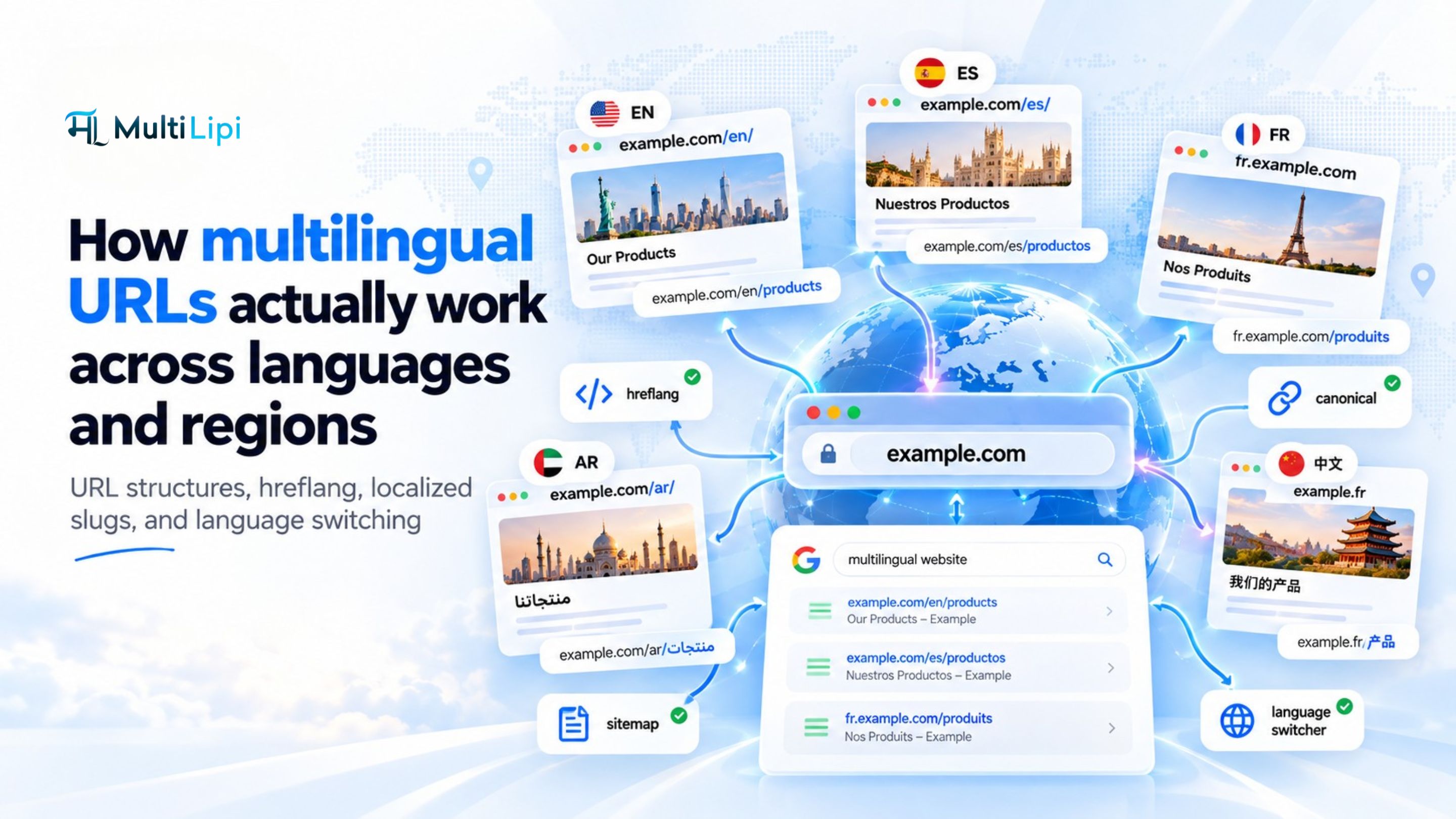
To maintain a clean global hierarchy, separate language versions into distinct, crawlable URL pathways. Avoid dynamic URL parameters such as ?lang=es and avoid browser-only translation widgets, because crawlers often cannot treat them as independent localized pages.
| URL Architecture | Example Format | Technical SEO Impact |
|---|---|---|
| Subdirectories | example.com/fr/ |
Highly recommended. Consolidates domain authority, centralizes link equity, and is easiest to maintain at scale. |
| Subdomains | de.example.com |
Moderate. Useful for decentralized international teams, but may fragment authority across properties. |
| ccTLDs | example.co.uk |
High cost / high trust. Strong local relevance, but every market needs separate SEO authority building. |
⚠️ Technical Warning
Never use IP-based automatic redirects to force crawlers into one language folder. Googlebot and many AI crawlers may access sites from US-based locations. If you force-redirect them, they may never discover your international pages.
✅ Critical Localization Step
Translate your URL slugs. An English slug on a German site, such as /de/pricing, creates cognitive friction. A localized slug such as /de/preise better matches regional search intent.
2. Deploy Flawless Hreflang Tags
Hreflang tags are the technical backbone of global search. They act as a relational map, telling search engines which language and regional version of a page to serve to each user. Without a correct hreflang cluster, translated pages can look like duplicates and compete against each other.
Hreflang Cluster Rules
Bidirectional confirmation: every language page must point back to every other language page in the cluster.
x-default fallback: specify the default page for users whose language does not match a localized version.
Automated checks: audit clusters with the MultiLipi Hreflang Checker.
<link rel="alternate" hreflang="en" href="https://example.com/" />
<link rel="alternate" hreflang="fr" href="https://example.com/fr/" />
<link rel="alternate" hreflang="de" href="https://example.com/de/" />
<link rel="alternate" hreflang="x-default" href="https://example.com/" />
Pro Tip: For large websites with 10+ languages, hreflang in XML sitemaps can be cleaner than placing every alternate tag inside every HTML page. It reduces page-head complexity and can simplify monitoring with a sitemap validation workflow.
3. Prioritize Deep Localization Over Literal Translation
Literal word-swapping is a liability. When an English industry idiom is directly translated into French, Spanish, Hindi, or Japanese, it may become technically readable but locally irrelevant. This is semantic drift: the page is translated, but it no longer matches how people search or how AI engines classify intent.
The Localization Quality Layer
Native Intent Mapping
Adapt messaging to local search terms, buyer vocabulary, legal norms, and cultural expectations.
Factual Density
Add localized proof, examples, FAQs, pricing context, and native expert terminology.
AI Extractability
Use concise sections, clean headings, and atomic paragraphs so models can retrieve facts confidently.
Measure content depth
Localized pages need enough useful content to stand alone. You can inspect content length and density with the Word Count Tool.
Avoid the JavaScript trap
If translated content loads only through client-side JavaScript, AI crawlers may see the original HTML. Study the difference in our translation vs localization guide.
4. Use Entity Disambiguation with Multilingual Schema
Modern search has moved from strings to entities. Schema markup, especially JSON-LD, translates your human-readable page into structured information that machines can understand quickly. For global websites, schema prevents algorithms from treating each language version as a disconnected brand.
Consistent @id
Use the same organization identifier across all language versions to unify your brand entity.
Translate values, not code
Localize names, descriptions, offers, job titles, reviews, and product details.
Schema Warning: Do not copy-paste English schema into translated pages. A Spanish query needs Spanish schema values to achieve maximum relevance. Use the Schema Checker and read the multilingual schema markup guide before scaling this across markets.
5. Optimize for Global Generative AI: The GEO Layer
Traditional SEO helps your global site get indexed. GEO helps your brand get cited. To adapt to the agentic web, multilingual content must be structured for retrieval, synthesis, and answer generation.
Machine-Readable Localization
BLUF Architecture
Start each section with a concise direct answer that a retrieval pipeline can extract.
llms.txt Roadmap
Guide AI crawlers to your most valuable localized pages with an llms.txt generator.
Token Efficiency
Reduce crawling friction by keeping sections modular, factual, and easy to parse.
Formatting Tip: AI RAG pipelines struggle with walls of text. Break localized content into modular 2–3 sentence paragraphs, use descriptive headings, and build from LLM optimization principles.
6. Continuous Monitoring and Technical Audits
Multilingual SEO is not a one-time deployment. CMS updates, routing changes, translated slug changes, broken canonicals, and inconsistent schema can silently damage global visibility. Continuous monitoring protects your Share of Answer.
Audit machine readability
Run weekly checks with the SEO Analyzer to find missing meta tags, rendering issues, broken links, and crawlability problems.
Validate crawl instructions
Use the Robots Validator, Canonical Validator, and sitemap checks to prevent accidental blocking.
Track regional content quality
Monitor localized metadata, page titles, translated URLs, and keyword intent across each target market.
Track AI citation visibility
Move beyond keyword ranks. Measure whether AI engines mention, retrieve, and cite your localized assets for high-intent queries.
Frequently Asked Questions
Does translating my website automatically improve SEO?
No. Simple translation creates readable content for humans, but it does not provide the backend infrastructure search engines need. You still need hreflang tags, localized URL slugs, translated metadata, schema markup, clean canonical signals, and indexable page structures.
Can I use AI tools like ChatGPT for website translation?
AI translation is fast, but generic output often misses local search intent, cultural nuance, glossary consistency, and technical SEO setup. A specialized website translation workflow combines AI speed with SEO, glossary, URL, schema, and hreflang automation.
What is the difference between multilingual SEO and multilingual GEO?
Multilingual SEO focuses on ranking translated pages in traditional search results. Multilingual GEO focuses on structuring localized content so AI answer engines can retrieve, synthesize, and cite your brand as the source of truth. Explore the full distinction in the Multilingual GEO Guide.
Do I need a different domain for every country?
Not necessarily. ccTLDs can create strong local trust, but they are expensive to manage and require separate authority building. For most SaaS, ecommerce, and B2B brands, localized subdirectories such as /fr/ or /de/ are easier to scale.
How do I prevent AI engines from mixing up regional data?
Use flawless bidirectional hreflang tags, consistent canonical logic, localized schema values, and unique regional details. This prevents AI systems from showing UK pricing to a US buyer or merging separate language pages into a single ambiguous source.
Conclusion: Engineering Global Authority
Implementing multilingual SEO is not a one-time project; it is the continuous engineering of your global digital footprint. The winning brands combine rigorous technical foundations, flawless hreflang tags, dedicated URL structures, deep localization, and entity-driven schema.
When you combine this with entity optimization and AI-ready formatting, your website is not just found across borders. It becomes the source that search engines and generative engines trust enough to cite.
Ready to architect your global presence?
MultiLipi helps you translate your website, automate multilingual SEO, manage glossary rules, improve AI search visibility, and launch localized pages without rebuilding your stack.