The digital ecosystem is currently navigating a structural transformation that mirrors the shift from the directory-based web of the 1990s to the search-based web of the 2000s. For nearly two decades, the primary goal of digital marketing was to satisfy the algorithms of traditional search engines, primarily Google, to secure a spot in the "ten blue links." However, the emergence of Large Language Models (LLMs) and Generative Search has fundamentally decoupled information discovery from website traffic.
The Zero-Click Era
Search engine volume by 2026
as users migrate to AI interfaces
Organic CTR drop
with AI Overviews present
By 2026, it is projected that traditional search engine volume will decline by 25% as users migrate toward conversational interfaces that synthesize answers rather than providing a list of links. Within this "zero-click" era, the primary challenge for CMOs, SEO Managers, and Founders is no longer just ranking, but ensuring that their content is the authoritative source cited within an AI's generated response.
MultiLipi GEO Launch
As we launch MultiLipi GEO, the world's first Multilingual LLM Optimization platform, we are answering the most critical question facing global brands today: Is simple translation enough for AI visibility, or is deep localization the only way to survive? The data is conclusive—while translation opens the door, localization provides the Semantic Confidence required for AI models to trust and recommend your brand.
The Visibility Gap: Analyzing the Shift from Clicks to Citations
The existential anxiety felt by modern marketing leaders is backed by empirical data. Between June 2024 and September 2025, the impact of Google's AI Overviews (AIO) on organic traffic has been devastating, with organic click-through rates (CTR) plummeting by 61% since mid-2024. Even on queries without AI Overviews, organic CTRs fell 41%, suggesting users are simply clicking less everywhere as they turn to tools like ChatGPT and Perplexity.
The Citation Advantage
However, there is a "citation advantage" for brands that adapt. Being cited within an AI Overview earns a brand 35% more organic clicks than those ignored by the model.
To earn these citations, content must evolve from human-readable blogs to machine-distillable data. For a broader look at this evolution, explore our GEO guide.
Entity Optimization: Defining the Linguistic Divide
To optimize for the AI-first web, we must first define the core entities involved in international growth.
Website Translation
Translation is the process of converting text from one language to another while preserving linguistic accuracy. It focuses on literal word-swapping—for example, ensuring "Contact Us" becomes "Contáctenos".
⚠️ Limitation: Lacks cultural nuances and semantic anchors for AI comprehension
Website Localization
Localization is the comprehensive adaptation of the entire digital experience—including language, cultural nuances, imagery, local conventions, and regional regulations—to align with the values and expectations of a target market.
✅ Advantage: Provides semantic anchors AI needs for trust and citation
The Context Collapse Phenomenon
In the context of Generative Engine Optimization (GEO), the difference is profound. AI models do not just "read" your site; they ingest and reason with it using Retrieval-Augmented Generation (RAG). A purely translated site often lacks the "semantic anchors" an AI needs to distinguish a US-based entity from a regional one, leading to a phenomenon known as "Context Collapse".
The 327% Advantage: Why AI Favors Localized Content
A landmark study analyzing 1.3 million AI citations in 2026 revealed that translated and localized websites gain 327% more visibility in AI Overviews for non-English queries compared to untranslated sites.
More AI Visibility
Localized websites vs. untranslated sites in non-English queries
The "Translate-Train" Bias
The reason lies in the "Translate-Train" bias of major LLMs like GPT-4 and Gemini. These models are trained on corpora that are disproportionately English-centric. When a user queries in Spanish, the AI overwhelmingly prefers to cite content written natively in Spanish rather than performing its own real-time translation of an English source.
💡 By providing localized versions of your content, you are essentially providing the AI with a pre-optimized "grounding source" in its native logic. This alignment is a core feature of our MultiLipi technology stack, which ensures your site is machine-readable across 120+ languages.
The Silent Killer: How Literal Translation Triggers AI Hallucinations
AI hallucinations occur when an LLM confidently invents meaning that does not exist or misrepresents facts. In a global business context, literal translation is a primary trigger for these errors.
The Problem of "Semantic Noise"
Literal translation often produces "semantic noise"—grammatically correct text that lacks the cultural markers of an authoritative source. When an AI encounters a page that sounds like a machine-translated clone, its Semantic Confidence Score drops.
Result:
The AI may ignore your site entirely or, worse, cross-contaminate data between regions.
Case Example:
An AI may retrieve a US pricing tier from an English-only site and hallucinate that it applies to the UK market, leading to incorrect quotes and legal risks.
To prevent this, brands must move from "word-swapping" to "transcreation"—injecting local entities like regional landmarks, local regulations, and currency conventions. You can audit your current site's vulnerability to these errors using our SEO analyzer.
Localization as the New E-E-A-T Signal
Google's 2026 algorithm update placed unprecedented emphasis on the first 'E' in E-E-A-T: Experience. In an era where AI can synthesize "Expertise" by aggregating existing data, real-world "Experience" has become the ultimate differentiator.
Localization is the bridge to demonstrating Experience in local markets. A localized site shows the AI that you are not just a global entity, but a local expert. This involves:
Hyper-Local Landmarks
Mentioning specific regional events or climate conditions (e.g., "designed for Scottish Highlands rain") acts as a strong semantic anchor.
Visual Proof
AI models are multimodal; they "see" images as proof of real-world usage. Using original, region-specific imagery helps validate claims that literal translation cannot.
Cultural Grounding
Adapting examples to match local norms—such as omiyage culture in Japan—aligns content with locally dominant semantic expectations.
This approach is detailed in our guide on LLM optimization, which focuses on building authority across 120+ languages.
The MultiLipi Parallel Optimization Model
At MultiLipi, we have evolved beyond website translation. As showcased in our recent launch, our mission is to build the "Architect of the AI-First Web." We achieve this through a Parallel Optimization Model that addresses three layers of visibility simultaneously:
Three Layers of Visibility
Traditional SEO
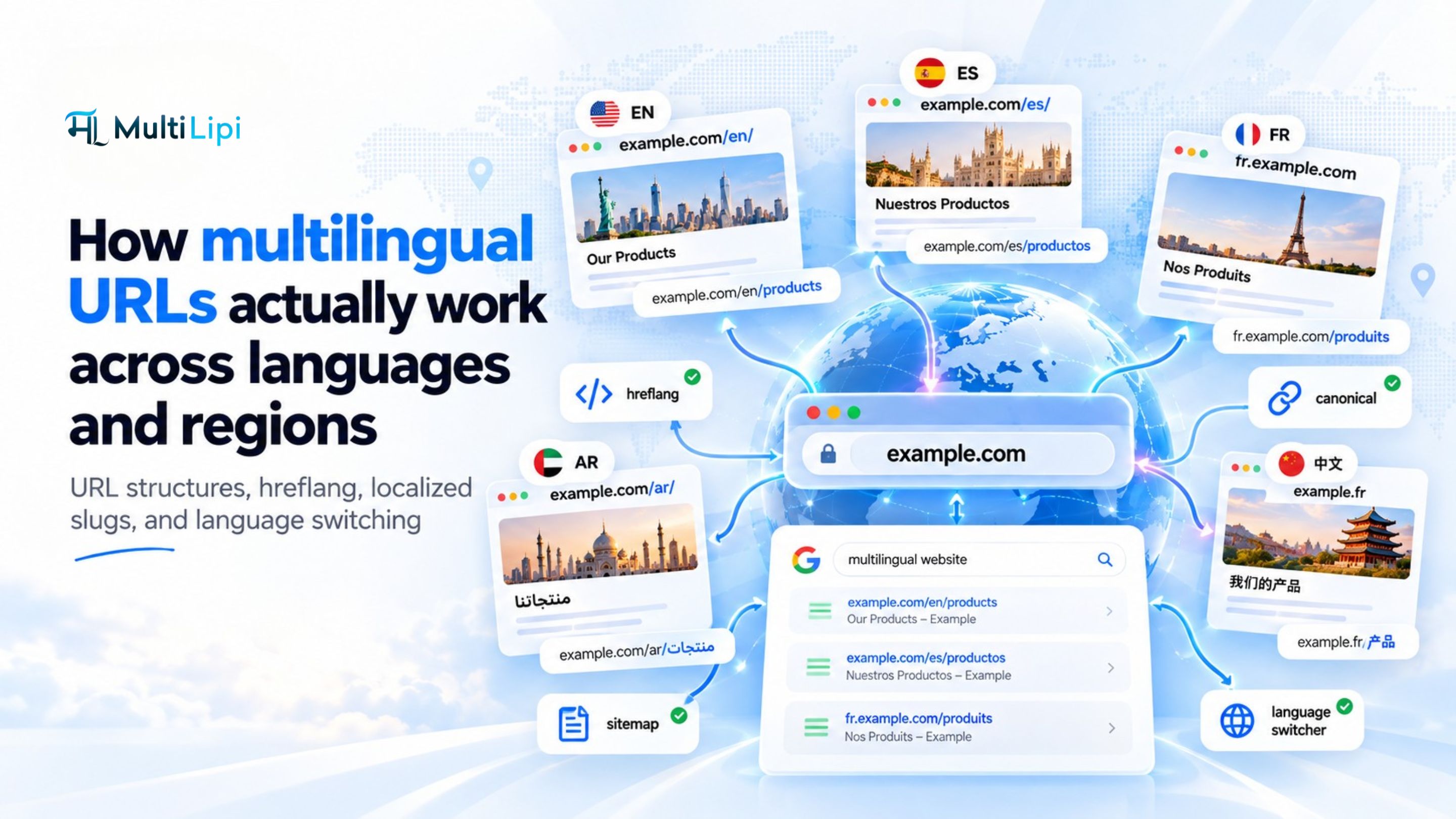
Managing clean URL structures, hreflang tags, and localized metadata to win the "blue links".
Check your foundations with our hreflang checker.
Answer Engine Optimization (AEO)
Structuring localized content into clear Q&A formats and FAQ schema to win position zero and voice search.
Learn more in our AEO guide.
GEO and LLM Optimization
Using llms.txt and Knowledge Graph tags to build unshakeable AI trust.
Visit our blog for tactical updates on this layer.
By using our llms.txt generator, brands can provide AI crawlers with a curated roadmap of their highest-value, localized assets, bypassing the code bloat that typically causes hallucinations.
Token Economics: The "Cost to Read" Your Website
A critical, yet overlooked aspect of AI visibility is Token Economics. Large Language Models do not read like humans; they process "tokens," and every token has a computational cost.
The HTML Tax
Standard HTML pages are laden with "noise"—navigation menus, JavaScript, and ads—that challenge AI comprehension.
The Markdown Advantage
Research shows that providing content in Markdown can reduce token usage by nearly 30% and improve model accuracy by over 7%.
Localized Markdown mirrors—accessible by appending .md to a URL—allow AI agents to ingest your site's "Source of Truth" with 95x fewer tokens than an HTML homepage. This makes your site significantly more "citable" during time-sensitive inference.
Estimate your potential savings with our free word count tool.
Actionable Roadmap for CMOs and Founders
To stop the bleeding of organic traffic and start building AI-era authority, follow this strategic roadmap:
Audit Your Entity Hubs
Identify your 5-10 highest-value pages (homepage, pricing, core services). These must be deeply localized, not just translated.
Action: Use our AI SEO analyzer to identify content gaps.
Standardize Your Global ID
Implement Multilingual Schema Markup (JSON-LD) using a stable @id across all language versions. This tells the AI that your French and Spanish pages represent the same global entity.
Action: Our schema generator automates this process.
Deploy llms.txt
Create a curated roadmap specifically for AI bots like GPTBot and ClaudeBot. This file should link to your most authoritative, localized Markdown summaries.
Monitor "Share of Synthesis"
Traditional keyword ranks are misleading. Start tracking your "Reference Rate"—the percentage of time an LLM cites your brand for a non-branded query compared to your competitors.
The Economic Imperative of the Agentic Web
The shift toward localized, structured data is not merely a technical trend; it is a fundamental adaptation to the economics of the agentic web. By 2028, it is predicted that 90% of B2B buying will be AI agent intermediated, pushing over $15 trillion of spend through AI exchanges.
of B2B buying AI-intermediated
by 2028
of B2B spend through AI
flowing through exchanges
In this future, your brand is no longer just selling to a person; you are selling to a machine that represents a person. If an AI agent cannot verify your technical specs or regional compliance in its native "logic," it will exclude you from the negotiation entirely.
Localization provides the "verifiable operational data" that these agents use as currency. For global brands, the message is clear: The future of traffic is not in the links we build, but in the context we provide. By mastering localization, you are not just optimizing for a bot; you are architecting the authoritative identity of your brand in a borderless, AI-first world.
Ready to Scale Global Visibility?
Make your website multilingual and AI-ready in just 5 minutes
Explore MultiLipi Pricing