The Search Landscape Has Changed Forever
If you feel like your hard-won search traffic is evaporating, you're not imagining it. A seismic shift is underway in how people find information online.
For decades, Search Engine Optimization (SEO) meant chasing those top 10 blue links on Google, optimizing keywords and backlinks to win clicks from a list of search results. But in 2026, users are increasingly not clicking at all.
They're getting single, synthesized answers from AI chatbots and search engines themselves, without ever visiting a website. Welcome to the era of Generative Engine Optimization (GEO)—a new approach focused not on ranking in search results, but on being the trusted source within AI-generated answers.
🎯Key Insight
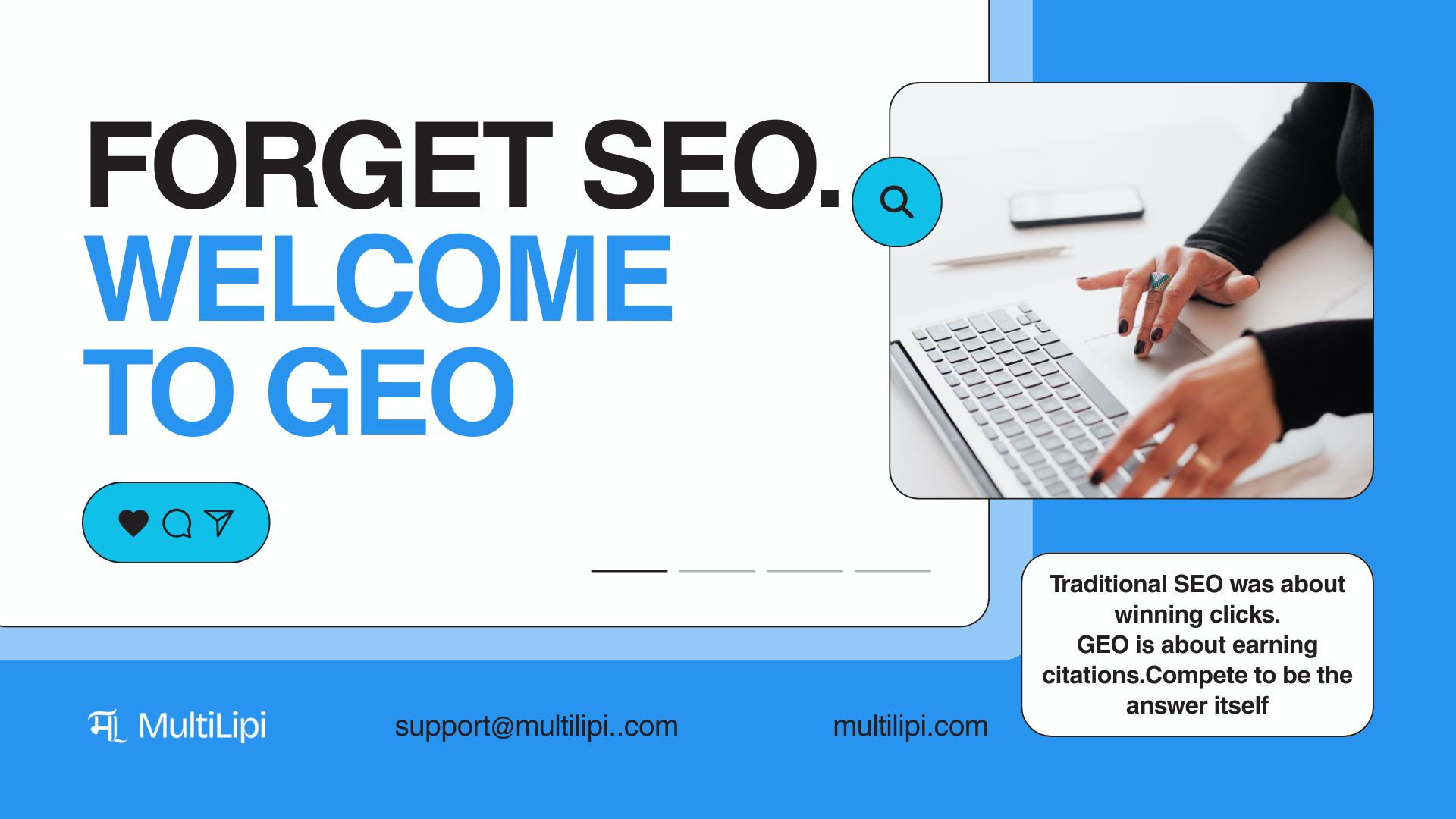
Traditional SEO was about winning clicks from search results; GEO is about earning citations in AI-driven answers. In other words, you're not just competing for rank—you're competing to be the answer itself.
The Zero-Click Reality
The numbers tell a stark story. By mid-2025, approximately 65% of Google searches ended without a click—meaning users found what they needed directly on the search results page, often through AI-generated summaries, featured snippets, or Knowledge Panels. On mobile devices, where screen real estate is limited and AI answers are even more prominent, this zero-click rate climbs to 77%.
Even more alarming for traditional SEO practitioners: research shows that when Google's AI Overview appears at the top of search results, the click-through rate to organic results below drops by a staggering 61%. This means that even if you've achieved that coveted #1 ranking, the majority of users may never see your link because they've already received their answer from the AI.
This isn't a temporary blip or a passing trend. It's a fundamental transformation in how information is discovered and consumed online. The shift from traditional search engines to AI-powered answer engines represents the most significant change in digital marketing since the advent of mobile search.
SEO vs. GEO: From Blue Links to Answer Engines
To understand why GEO is the new mandate, let's first clarify the distinction between the old game and the new reality.
What is SEO (Search Engine Optimization)?
SEO is the practice of optimizing your website to rank higher in search engine results pages (SERPs) so that users click through to your site. Success in SEO has long been measured by organic traffic and rankings. The discipline involves targeting specific keywords, earning backlinks to build authority, optimizing technical elements like site speed and mobile responsiveness, and creating content that satisfies user intent.
The ultimate goal has always been to attract a click from the SERP to your site—it was fundamentally about competing for visibility among other links. Traditional SEO practitioners focused on understanding Google's ranking algorithms, building domain authority through link acquisition, and optimizing on-page elements to signal relevance and quality.
However, this model is showing its age. Today, Google's featured snippets, Knowledge Panels, and new AI-powered summaries are delivering information directly on the results page. The SERP itself has become the destination, not just a waypoint to other websites. For a deeper dive into traditional optimization strategies, see our comprehensive Hreflang SEO guide.
What is GEO (Generative Engine Optimization)?
Generative Engine Optimization (GEO) is the practice of optimizing your content specifically for AI-driven answer engines rather than just traditional search engines. In plain terms, GEO is about making your content quotable and citable by AI systems like ChatGPT, Google's Search Generative Experience (SGE), Perplexity AI, and voice assistants like Amazon Alexa.
Instead of fighting to be result #1 on a page of links, you're fighting to be the source that an AI pulls into its single synthesized answer. Success isn't measured just by clicks and traffic volume, but by citations, mentions, and visibility within AI answers. The user might never click your link—but your brand's insight, data, or expertise still influenced their decision, built your authority, and potentially led to future conversions through brand recall.
GEO requires a fundamental shift in how we think about content creation. Rather than optimizing for keywords and link metrics, we optimize for entities, structured data, factual accuracy, authoritative sourcing, and clear, citable statements. It's about becoming a source that AI systems trust and reference repeatedly across thousands of queries.
The Evolution: SEO → GEO
The Fundamental Shift
Traditional SEO Approach
Modern GEO Approach
Why GEO Is the New Standard for 2026
The shift to GEO is driven by dramatic evolutions in both user behavior and search technology. Understanding these forces is critical—because sticking to traditional SEO alone means watching your visibility fade as the digital landscape transforms around you.
1. The Explosion of Zero-Click Searches
As mentioned earlier, more than half of all searches now end without a click. This isn't because users are dissatisfied—quite the opposite. Search engines and AI systems have become so good at extracting and presenting information that users can get what they need without ever leaving the results page. Google's featured snippets, Knowledge Graphs, AI Overviews, and direct answers satisfy queries instantly.
For businesses, this creates a paradox: you can provide the best answer and still receive zero traffic. Your content might be featured prominently in an AI answer or snippet, giving users exactly what they need, but never driving them to your site. This is why optimizing for citations and brand mentions—not just clicks—has become essential.
2. AI Cannibalization of Organic Traffic
Studies have documented a dramatic impact on organic click-through rates when AI-generated content appears at the top of search results. One comprehensive analysis found that the introduction of Google's AI Overview feature led to a 61% drop in clicks to traditional organic results. Think about that: achieving the #1 organic position used to guarantee significant traffic, but now it can mean very little if an AI answer dominates the viewport.
This isn't limited to Google. Bing's integration with ChatGPT, the rise of Perplexity AI as a search alternative, and the increasing sophistication of voice assistants all point to the same trend: AI-mediated search is becoming the norm, and traditional result listings are becoming secondary.
3. AI as the Primary Research Tool
Perhaps the most significant shift is behavioral. According to recent research, 89% of B2B buyers now use generative AI tools like ChatGPT, Claude, or Gemini for research and comparison during their buying journey. They're asking detailed questions, comparing solutions, and making preliminary decisions—all before they ever visit a vendor website.
If your content isn't structured in a way that AI systems can understand, extract, and cite, you're simply invisible to these buyers. They're forming opinions and shortlisting vendors based on what AI tells them, and if you're not part of that conversation, you've lost the opportunity before it even begins.
4. Changing Consumer Expectations
Users have fundamentally changed how they search. Traditional search queries were terse—typically 2-4 words like "best CRM software" or "Italian restaurant Chicago." AI search queries, by contrast, average 23 words because people have learned they can ask detailed, conversational questions and receive comprehensive answers.
Users now expect direct, synthesized answers rather than a list of links to explore. They want the search engine or AI to do the work of aggregating information from multiple sources and presenting a coherent response. This expectation shift fundamentally changes what "search optimization" means.
5. Projected Decline of Traditional Organic Traffic
Gartner, one of the world's leading research and advisory companies, has made a bold prediction: by 2028, organic search traffic to brand websites will drop by 50% or more due to AI-powered search and answer engines. This isn't fear-mongering—it's a data-driven forecast based on current adoption trends and technological trajectory.
⚠️Critical Industry Warning
Gartner predicts that by 2028, organic search traffic to brand websites will drop by 50% or more due to AI-powered search. This isn't a distant threat—early indicators suggest it's already happening. Companies that fail to adapt to GEO strategies risk losing half their organic traffic within just 2-3 years.
The good news? This transformation also creates opportunity. Companies that master GEO early can capture mindshare and establish authority in AI systems before their competitors catch on. Being cited by AI becomes a competitive moat—once an AI system identifies your brand as authoritative on a topic, it tends to reference you repeatedly.
The GEO market itself reflects this opportunity. Valued at $886 million in 2024, the market for GEO tools, services, and expertise is projected to reach $7.3 billion by 2031, growing at a compound annual growth rate of 32%. GEO is poised to become as fundamental to digital marketing as SEO has been for the past two decades.
The GEO Revolution by the Numbers
120+ Languages, 32% CAGR Growth
GEO is becoming as fundamental to digital marketing as SEO, with explosive market growth across all global languages.
The GEO Playbook: Optimizing for Answer Engines
Now that we understand why GEO matters, let's discuss how to implement it. Practicing GEO requires focusing on several key pillars that make your content "AI-friendly" and citation-worthy.
Answer-First Content
Provide clear, direct answers up front. Use heading tags for questions and answer immediately after.
Structured Data & Schema
Schema markup turns content into machine-friendly data that AI systems can easily extract and cite.
Entity Focus
AI models understand entities rather than keywords. Use standard terminology and clear entity definitions.
Authority Signals
Display E-E-A-T signals: author credentials, publication dates, citations, and expertise indicators.
Pillar 1: Answer-First Content Structure
Don't bury the lede. For every important question your audience might ask, provide a clear, direct answer up front. This might mean opening your blog posts with a one-paragraph summary that directly addresses the title question, or creating a dedicated FAQ section that provides immediate answers before diving into detailed explanations.
Use heading tags strategically. An H2 that says "What is Schema Markup?" should be immediately followed by a clear definition, not several paragraphs of preamble. AI systems are excellent at identifying these question-answer patterns and will preferentially cite content that follows this structure. See our Guide to Multilingual SEO for more content structuring best practices.
Pillar 2: Structured Data and Schema Markup
Schema markup is code that helps search engines and AI systems understand your content's context and meaning. It turns your content into machine-friendly structured data. AI systems love this because it removes ambiguity—for instance, FAQ schema explicitly tells an AI, "Here is a question and here is its answer," making it trivially easy to extract and cite.
Research consistently shows that pages with FAQ schema, Article schema, or HowTo schema have significantly higher citation rates in AI answers. For multilingual sites, this becomes even more critical—you need to ensure your schema is properly localized for each language version. Our Hreflang implementation guide covers technical schema localization in detail.
Pillar 3: Entity Focus and Semantic Clarity
AI models understand entities—people, places, concepts, organizations, and products—rather than just keywords. An entity is a unique, well-defined thing that exists in the world. "Apple" the company is an entity; "apple" the fruit is a different entity. AI systems use context to disambiguate, but you can help by being crystal clear about what entities your content addresses.
Make your entity references explicit. Define new or niche terms when you first introduce them—exactly as we've done with "GEO" in this article. Use consistent terminology throughout your content. Internally link to other content that establishes your expertise on related entities. This builds topical authority, signaling to AI systems that you're a comprehensive, reliable source on an entire domain of knowledge, not just individual keywords.
Pillar 4: Authority and Trust Signals (E-E-A-T)
AI answer engines are extremely selective about which sources to trust and cite. They preferentially reference authoritative, well-established sources over unknown or questionable ones. This makes E-E-A-T (Experience, Expertise, Authoritativeness, Trustworthiness) more important than ever.
To build trust, ensure your facts are backed by credible sources. Link out to authoritative entities—citing Gartner, Google, or academic research adds credibility. Display author credentials prominently, including relevant expertise and experience. Use publication and update dates to show content freshness. Include citations and references. All these signals help AI systems assess whether your content is trustworthy enough to cite.
For B2B and enterprise content, consider adding author bios, company credentials, certifications, case study results, and data sources. The more you can demonstrate expertise and authority, the more likely AI systems are to treat your content as a primary source worth citing repeatedly.
The Shift from SEO to GEO: A Strategic Breakdown
The transition from traditional search to generative engines marks a fundamental change in how digital content is valued and discovered. Understanding how the two strategies differ across key dimensions helps clarify what needs to change in your approach.
Primary Goal: Clicks vs. Citations
Traditional SEO's primary goal was straightforward: rank high enough to win clicks from the SERP to your website. GEO's goal is different: earn citations and mentions within AI-generated answers, even if users never visit your site. This requires a mindset shift—you're optimizing for influence and brand authority, not just traffic metrics.
Success Metrics: Traffic vs. Brand Authority
SEO success was measured by rankings, organic traffic, and conversion rates from that traffic. GEO success requires new metrics: citation frequency (how often AI systems reference your content), brand mention rate (how often your brand appears in AI answers), answer inclusion rate (percentage of relevant queries where you're cited), and authority score (how AI systems assess your topical expertise). These metrics are harder to track but increasingly critical to understand.
Core Tactics: Keywords vs. Entities
SEO tactics centered on keyword research and backlink acquisition. GEO tactics focus on entity optimization, schema implementation, factual accuracy, source credibility, and semantic clarity. While keywords still matter for discovery, they're secondary to being recognized as an authoritative source on specific entities and topics.
User Journey: Multi-Step vs. Instant
The traditional SEO user journey was multi-step: user searches, reviews SERP, clicks a result, consumes content on your site. The GEO user journey is often single-step: user asks a question, AI provides a synthesized answer drawing from multiple sources. Your content influences the user's understanding and decision-making, but they may never directly interact with your website.
Competitive Landscape: 10 Pages vs. Entire Knowledge Base
In SEO, you competed with roughly 10 other websites for visibility on page 1 of search results. In GEO, you compete with the AI's entire knowledge base—potentially millions of sources. This makes building topical authority and trust signals even more critical. You need to be not just good, but definitively authoritative on your topic.
The Multilingual GEO Challenge
If optimizing for one language is complex, imagine doing it for 50, 100, or 120 languages. For global brands and international companies, the multilingual dimension of GEO is both a massive challenge and an enormous opportunity.
The Global Opportunity
While most companies focus their GEO efforts on English-language content, this overlooks a massive opportunity. Multilingual markets represent approximately 75% of global internet users. AI systems like ChatGPT, Google's Gemini, Anthropic's Claude, and others are increasingly sophisticated in dozens of languages—which means international audiences are also getting AI-generated answers to their queries.
If you're not optimized for GEO in French, Spanish, German, Japanese, Arabic, Hindi, and other major languages, you're invisible to billions of potential customers who are using AI search in their native language. They're making purchasing decisions based on AI recommendations, and if your brand isn't part of that conversation in their language, you've lost the opportunity.
Unique Challenges of Multilingual GEO
Multilingual GEO isn't simply a matter of translating your English content. Each language market has unique considerations. Schema markup needs to be localized, not just translated—cultural concepts and entities may differ. Hreflang tags must be implemented correctly to signal language and regional targeting to search engines and AI systems.
Entity consistency across languages is critical but challenging. Your brand name, product names, and key concepts need to be recognized as the same entities across all language versions. Content structure may need adaptation for cultural preferences—some cultures prefer direct, concise answers while others expect more context and relationship-building in content.
Perhaps most challenging: you need to monitor and measure AI citations across different language models and regional AI platforms. An AI system trained primarily on English data may not properly understand or cite your German content, and vice versa. This requires language-specific GEO strategies, not a one-size-fits-all approach.
Implementation Checklist
The MultiLipi Solution
MultiLipi was built specifically to solve the multilingual GEO challenge at scale. Our platform automates GEO optimization across 120+ languages, ensuring your content is properly structured, localized, and optimized for AI citations in every target market. From schema localization to entity mapping to cultural content adaptation, MultiLipi handles the complexity of multilingual GEO so you can focus on creating great content. Get started with our free tools: Schema Generator, LLMs.txt Generator, and SEO Analyzer. Learn more about our pricing and features.
The Future Is Already Here
The era of traditional SEO isn't completely over, but its dominance is fading fast. As AI-powered search becomes the default way people find information, the companies that thrive will be those that master Generative Engine Optimization.
GEO isn't just about adapting to new technology—it's about fundamentally rethinking how you create, structure, and present content. It's about becoming a trusted source that AI systems want to cite, not just a website competing for clicks.
The shift is happening now. Companies that adapt early will establish themselves as authoritative sources in AI systems, building a competitive advantage that compounds over time. Those that wait risk becoming invisible as the world moves to AI-mediated search.
The question isn't whether AI will change search—it already has. The question is whether your brand will be part of the answer.
If you operate in multiple languages, the complexity multiplies—but so does the opportunity. Being cited by AI systems in 50 or 100 languages means reaching billions of users you might never have reached through traditional SEO alone.
Ready to master GEO? Start by implementing the four pillars: answer-first content, structured data, entity focus, and authority signals. For multilingual implementations, consider platforms like MultiLipi that handle the complexity of GEO at scale across dozens or hundreds of languages.