
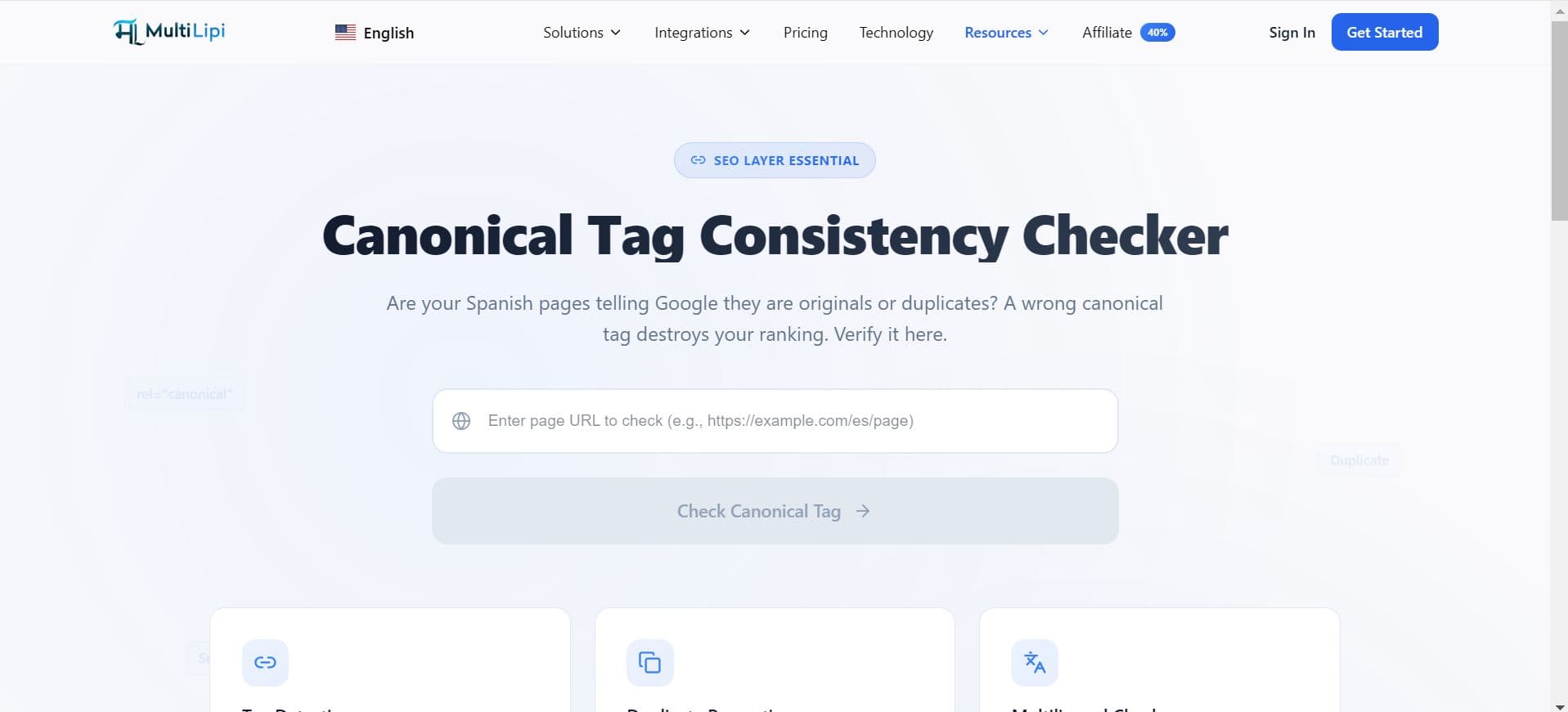
Prevent authority dilution and eliminate duplicate content penalties—at no cost.
In web architecture, Redundancy is a ranking killer. Search engines often find five versions of your homepage: http://, https://, www, non-www, and index.php. To a bot, these are five different pages with identical content. Without a rel="canonical" tag acting as the "Source of Truth," Google splits your ranking power across all five, ensuring none of them rank #1.
The MultiLipi Canonical Tag Checker is a free engineering utility that audits your source code to ensure every page explicitly declares its master version, consolidating your SEO authority into a single, powerful signal.
The "Authority Leak"
Why signals get diluted.
Every inbound link to your site counts as a "vote."
The Problem
If 50 people link to yoursite.com and 50 people link to www.yoursite.com, Google sees two weak pages with 50 votes each.
The Fix
A proper Canonical Tag tells Google: "Count all 100 votes for https://www.yoursite.com." This consolidation is often the difference between Page 1 and Page 2 rankings.
The Audit Protocol
How to validate your consolidation logic.
Don't assume your CMS handles this correctly. Verify the output.
Access the Free Tool
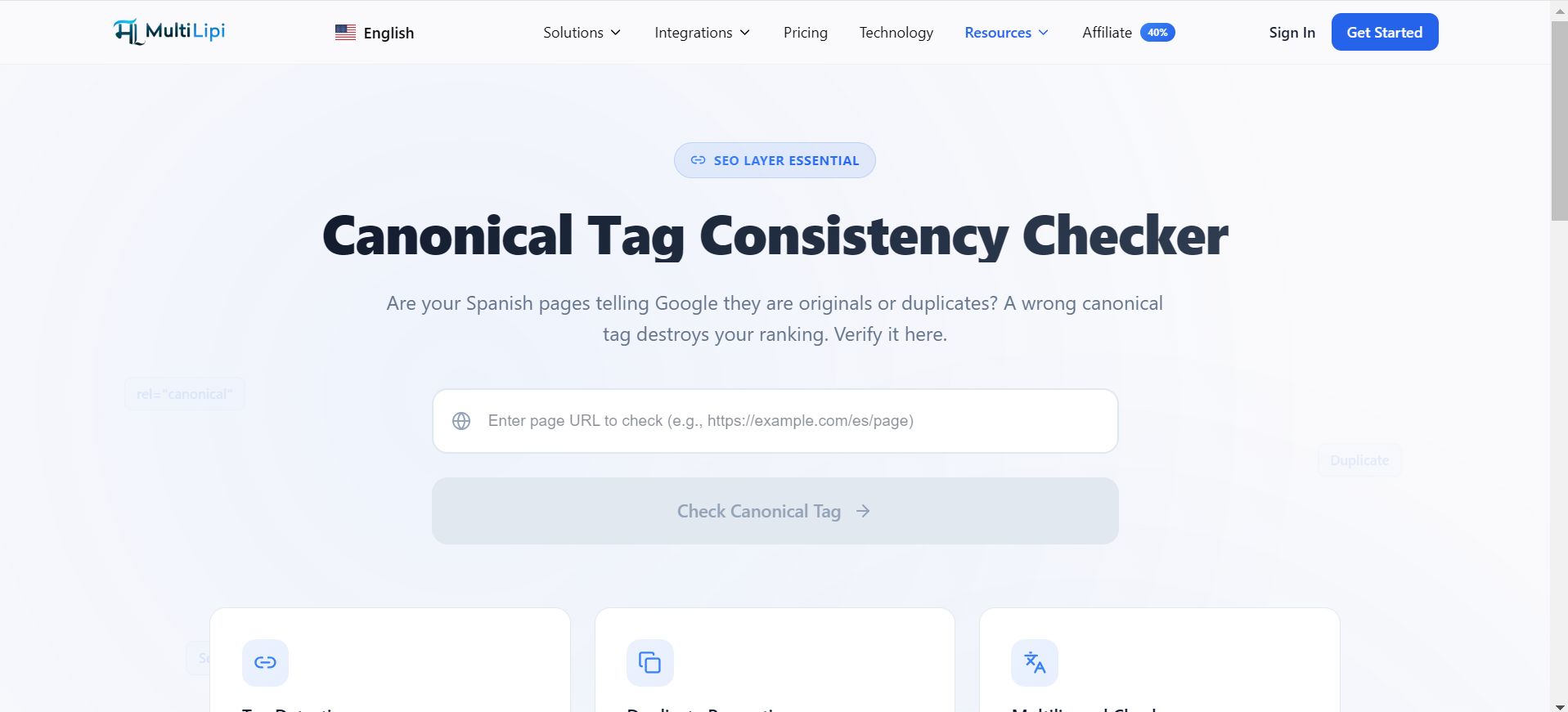
Navigate to the Canonical Tag Checker.
Input Endpoint
Enter a specific URL (e.g., https://example.com/blog/post-1?tracking=123).
Execute Scan
Click the Check Now button.
Review Logic
Examine Tag Presence, Target Validation, and Self-Referencing Check.
Review Logic:
Tag Presence: Confirms the <link rel="canonical"> exists in the <head>
Target Validation: Verifies that the tag points to a valid, reachable URL (200 OK) and not a redirect loop or 404
Self-Referencing Check: Confirms that the master page correctly points to itself (a critical SEO best practice)
Optimizing for AI Attribution
Protecting the "Original."
In Generative Engine Optimization (GEO), AI models look for the original source of information to cite.
Syndication Risk
If you republish your article on Medium or LinkedIn, an AI might cite Medium instead of you.
Canonical Defense
By using cross-domain canonicals (checking that your syndicated copies point back to your domain), you force the AI to recognize your site as the primary author and authority.
Multilingual Hygiene
Global signal management.
In a localized infrastructure, Canonical tags must work in harmony with Hreflang tags.
The Rule
Your French page (/fr/) should canonicalize to itself (/fr/), not to the English version.
The Audit
Use our tool to scan your translated sub-directories and ensure they aren't accidentally telling Google that they are "duplicates" of the English page, which would cause them to be de-indexed.