
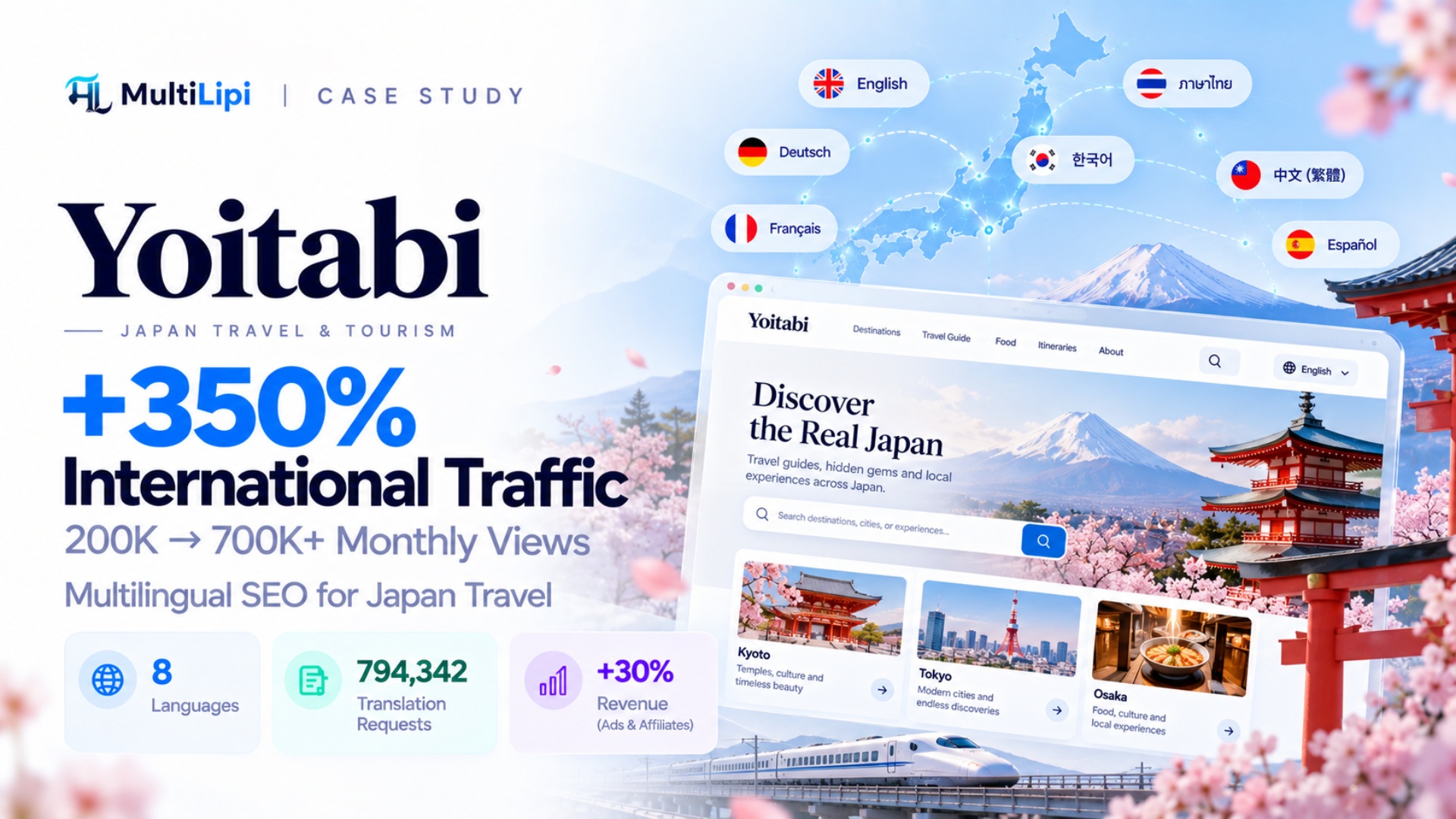
At a Glance: The Tourism Metrics
Real results verified from the MultiLipi Command Center:
1. The Context: The Inbound Boom
Yoitabi (meaning "Good Trip") is a leading online publication dedicated to uncovering Japan's local travel stories. With the Yen at historic lows, inbound tourism to Japan is exploding. Millions of tourists are actively searching for "Hidden Kyoto Spots" or "Best Ramen in Osaka."
⚠️ The Disconnect
Yoitabi had the best content, but it was locked in Japanese.
- •The "Pre-Trip" Gap: A tourist in Bangkok searching for "Japan Visa Guide" in Thai (คู่มือวีซ่าญี่ปุ่น) would never find Yoitabi's Japanese article.
- •The Missed Revenue: By not speaking the language of the tourist during their research phase, Yoitabi was losing millions of ad impressions to English-language competitors like TripAdvisor or Reddit.
2. The Challenge: SEO for Complex Scripts
Scaling a Japanese site into Thai, Korean, and Traditional Chinese presents unique technical hurdles.
A. The "Mixed Script" Indexing Problem
Asian languages use different character sets (Kanji, Hangul, Thai Script).
B. The Hreflang Matrix
With 8 languages, cross-referencing became complex.
rel="alternate" tags for every single article, ensuring the German user always landed on /de/ and never on /ja/.3. The Solution: Automated Tourism Infrastructure
Yoitabi integrated MultiLipi's SEO Infrastructure to automate their inbound strategy.
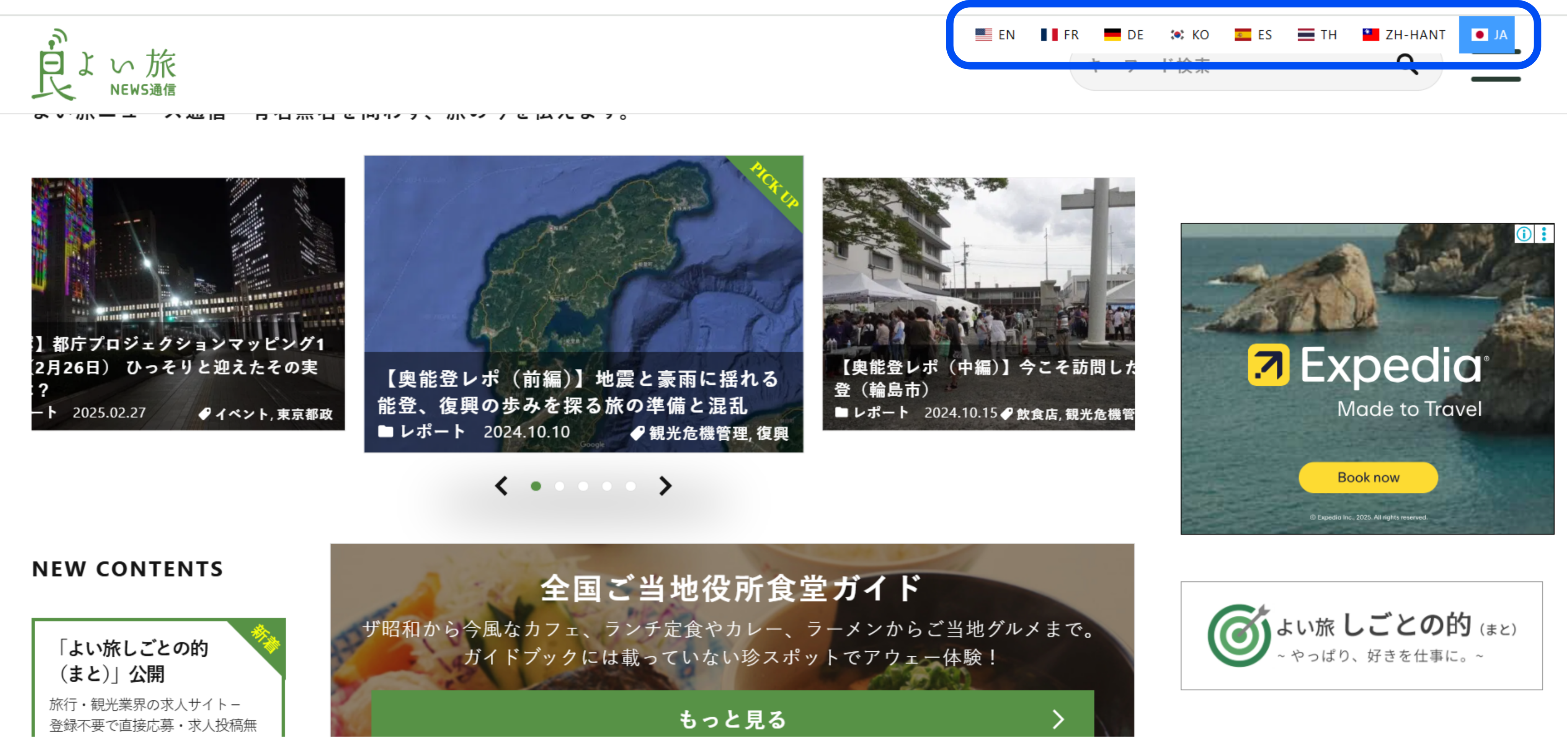
✨ 8-language travel guide deployed — JA, EN, TH, KO, DE, FR, ZH-HANT, ES — with perfect Unicode support for mixed scripts and localized URL slugs
Step 1: The Indexing Engine (Server-Side Translation)
Step 2: Localized URL Slugs
Step 3: The "Zero-Dev" Launch
4. The Data Deep Dive: 350% Growth
The results validated the "Asian Inbound" strategy.
🌏 Unlocked: The Thai & Korean Corridors
The traffic breakdown revealed that the biggest opportunities were regional neighbors, not just Westerners.
Thai (106,617 Views) became a massive traffic driver.
Thai tourists are one of the fastest-growing segments in Japan, and Yoitabi captured this wave perfectly.
Korean (103,030 Views) traffic proved localization wins.
Providing detailed, localized content wins over generic travel aggregators every time.
German (100,604 Views) showed high-spending European travelers dig deep into cultural guides.
English (196k Views) remained the top language, serving global travelers worldwide.
💰 Metric: 30% Revenue Lift
More traffic equals more ad inventory.
📊 Metric: 794,342 Translation Requests
Nearly 800,000 translation requests covering thousands of travel guides.
5. Future-Proofing: The Next Leap (GEO)
What makes this case study truly impressive is that these results were achieved purely with Traditional SEO.
They Haven't Even Activated GEO Yet
Yoitabi achieved a 350% traffic lift simply by making their guides readable to Google in 8 languages.
Imagine the ceiling when they do.
Right now, they are winning on Google Search. But with their travel data already structured by MultiLipi, they are perfectly positioned to turn on LLM Optimization. This would structure their "Top 10" lists and itineraries into Data Entities, allowing them to become the cited authority when a traveler asks an AI agent: "Plan a 5-day itinerary in Tokyo for a Thai family."
Yoitabi won the Search battle. They are already armed for the AI travel war.
Yoitabi proved that content is the ultimate export. By using MultiLipi to index their guides in 8 languages, they increased their readership by 350% and captured the booming Asian tourism market. They didn't just translate words; they exported Japanese culture.