The Hybrid Translation Model: Balancing AI Speed with Human Precision

Executive Summary: The Strategic Imperative of the Hybrid Era
In the contemporary digital economy, the linguistic landscape of the internet has undergone a seismic shift. While English once served as the undisputed lingua franca of the World Wide Web, the democratization of digital access has inverted this reality. Today, the next billion internet users are coming online from regions where English proficiency is low, yet digital appetite is high. For global enterprises, this presents a formidable paradox: the sheer volume of content required to engage these diverse audiences creates a localization bottleneck that traditional human translation workflows cannot resolve due to prohibitive costs and slow turnaround times. Conversely, relying solely on raw artificial intelligence poses significant risks to brand integrity, cultural resonance, and search engine visibility.
This report posits that the solution lies in the Hybrid Translation Model, a strategic framework that harmonizes the computational velocity of Artificial Intelligence (AI) with the nuanced precision of human cognition. Often referred to as "Human-in-the-Loop" (HITL) or Machine Translation Post-Editing (MTPE), this model is not merely a compromise but an optimal operational standard for the modern age. By leveraging advanced platforms like MultiLipi, organizations can achieve what was once considered the "impossible triangle" of localization: speed, scalability, and quality.
Through an exhaustive analysis of industry data, technological trends, and comparative case studies, this document explores how the hybrid model allows businesses to translate millions of words instantly while reserving human expertise for the high-impact content that drives conversion. We will dissect the mechanics of Neural Machine Translation (NMT), the critical role of Multilingual SEO, and the economic advantages of adopting a tiered localization strategy. The findings suggest that the hybrid model is the only viable pathway for businesses aiming to scale globally without sacrificing the "native" experience that consumers demand.
Chapter 1: The Globalization Paradox and the Content Explosion

1.1 The Shifting Demographics of the Digital World
The strategic necessity of multilingual content is rooted in a fundamental shift in user behavior and demographics. Research consistently demonstrates a strong correlation between native-language content and consumer trust. Data indicates that over 72% of consumers prefer to spend their time on websites in their own language, and a significant majority are more likely to purchase a product if the description is localized, even if they speak English as a second language. This phenomenon, often described as the "Can't Read, Won't Buy" rule, underscores that language is not merely a medium of information transfer but a psychological signal of inclusion and safety. ,MultiLipi
However, the operational challenge is the volume of content. A decade ago, a company might have translated a static brochure site of 50 pages. Today, a typical SaaS platform, e-commerce retailer, or digital publisher generates dynamic content streams—blogs, support articles, product listings, and user-generated reviews—amounting to millions of words annually. The "long tail" of content has become infinite. To translate a 10,000-page website into 20 languages using traditional human translation workflows would require years of effort and millions of dollars, rendering it economically unviable for all but the largest tech giants.
1.2 The Failure of Binary Choices
Historically, organizations were forced to choose between two binary extremes, neither of which fully served the needs of the modern digital ecosystem:
- Traditional Professional Translation:
- Mechanism: Human linguists translating text segment by segment.
- The Cost Barrier: With professional rates hovering between $0.15 and $0.30 per word, translating a modest blog can cost hundreds of dollars per language.
- The Speed Bottleneck: A professional translator typically outputs 2,000 to 3,000 words per day. For a rapidly moving startup or news organization, this latency is unacceptable. By the time the content is localized, the market opportunity may have passed.
- Verdict: High quality, but unscalable.
- Raw Machine Translation (Legacy):
- Mechanism: Statistical Machine Translation (SMT) or early Neural networks without context.
- The Quality Deficit: While free and instant, raw MT historically struggled with context, idiom, and specialized terminology. It was prone to "hallucinations" fabricating information and failed to capture brand voice.
- The Trust Deficit: Content riddled with grammatical errors signals low quality to users, damaging brand equity and increasing bounce rates.
- Verdict: Scalable, but dangerous for brand reputation.
1.3 The Emergence of the Hybrid Paradigm
The Hybrid Translation Model bridges this chasm. It acknowledges a simple economic truth articulated by the Pareto Principle (80/20 Rule): roughly 80% of the translation workload (syntax, grammar, basic vocabulary) can be handled by AI in 20% of the time, while the remaining 20% of the effort (nuance, culture, compliance) provides 80% of the value.
By integrating advanced AI engines to handle the heavy lifting of bulk translation and deploying human editors to refine the output, companies can reduce costs by 30-50% while accelerating time-to-market. This is the philosophy behind MultiLipi, which democratizes access to this workflow by providing a unified platform where AI speed and human control coexist seamlessly.
Chapter 2: The Technological Foundation: From NMT to LLMs

2.1 The Evolution of Machine Translation
To trust the hybrid model, one must understand the technology powering it. We have moved far beyond the rigid, rule-based systems of the 1990s.
- Statistical Machine Translation (SMT): Used in the 2000s, this relied on probability and vast databases of bilingual text. It was effective for literal translation but often produced "word salad" because it lacked grammatical understanding.
- Neural Machine Translation (NMT): The current industry standard. NMT uses artificial neural networks to predict the likelihood of a sequence of words. Unlike SMT, it considers the entire sentence as a unit, resulting in far greater fluency and grammatical accuracy. Engines like DeepL and Google Translate are built on this architecture.3
- Large Language Models (LLMs): The frontier, represented by GPT-4 and Claude. These models understand context at a document level. They can follow instructions about tone (e.g., "translate this in a formal, legal tone") and can handle cultural adaptation better than pure NMT.
MultiLipi leverages these state-of-the-art models to provide the foundational layer of the hybrid workflow. By utilizing AI that understands context, the "first draft" generated by the system is often 85-95% accurate, leaving the human editor to focus solely on high-level refinement rather than basic correction.
2.2 The Risk of AI Hallucinations and the Need for Oversight
Despite these advancements, AI is not infallible. A phenomenon known as "hallucination" occurs when an AI model confidently generates false information. In a creative writing context, this might be amusing; in a medical or legal context, it is catastrophic.
Snippet highlights that high-stakes content contracts, medical instructions, compliance documents require Human-in-the-Loop (HITL) oversight to mitigate these risks. An AI might translate "execute a contract" (sign it) as "execute" (kill) in a certain context if not properly guided. Human oversight acts as the safety valve, ensuring that the efficiency of AI does not come at the cost of liability.
2.3 The "Uncanny Valley" of Brand Voice
AI tends to regress to the mean. It produces safe, statistically probable text. However, brands often differentiate themselves through improbable text—unique slogans, specific terminology, and a distinct voice. A luxury hotel wants to sound "exquisite," not just "good." A skater brand wants to sound "rad," not "excellent."
The hybrid model allows human editors to inject this brand personality back into the AI-generated text. Using tools like MultiLipi's Visual Editor, editors can ensure that the translation isn't just accurate, but that it feels right for the brand.
Chapter 3: The MultiLipi Architecture: A Platform Built for Hybrid

3.1 Democratizing Enterprise Localization
For years, the hybrid model was the domain of large enterprises using complex Translation Management Systems (TMS). MultiLipi has revolutionized this by packaging enterprise-grade capabilities into a user-friendly platform accessible to businesses of all sizes, from WordPress bloggers to Shopify merchants.
The platform functions on a "No-Code" basis, integrating directly into the website's infrastructure via a plugin or script. This eliminates the need for developers to extract strings or manage .po files manually, which was a major friction point in traditional localization.7
3.2 The Visual Context Advantage
One of the most persistent causes of translation error is lack of context. If a translator sees the word "Home" in a spreadsheet, they don't know if it refers to a "Home page," a "House," or the action "Go Home."
MultiLipi solves this with its Visual Translation Editor. This "What You See Is What You Get" (WYSIWYG) interface allows human editors to navigate the live website and edit translations in situ.
- Contextual Clarity: Editors see exactly where the text lives—on a button, in a footer, or as a headline.
- Design QA: Editors can immediately see if a German translation breaks the layout (German text is typically 30% longer than English) and adjust the phrasing to fit the design constraints.7
- Immediate Feedback: Changes are reflected instantly, closing the loop between editing and publishing.
3.3 The Three Pillars of MultiLipi’s Hybrid Workflow
The platform is built around three core pillars that facilitate the hybrid model:
- AI Automation (Speed): The system detects new content and translates it instantly into 120+ languages. This ensures 100% of the site is always available in the target language, eliminating "untranslated content" gaps.
- Human Control (Quality): The dashboard allows for granular control. Users can invite professional translators to review specific pages, or use the "Glossary" feature to enforce strict terminology rules (e.g., ensuring "Apple" remains "Apple" and isn't translated to the fruit).
- SEO Infrastructure (Growth): The platform handles the technical complexity of multilingual SEO automatically, a critical feature for driving traffic to the translated content.
For a detailed walkthrough of getting started, the (https://multilipi.com/blog/article/beginner-guide-website-localization) provides a comprehensive roadmap.
Chapter 4: The Economics of Hybrid: Cost, Speed, and ROI

4.1 Comparative Cost Analysis
The economic argument for the hybrid model is irrefutable. By treating translation as a tiered process, businesses can allocate budget where it matters most.
The hybrid translation model, as championed by MultiLipi, offers a compelling economic advantage by enabling businesses to allocate their translation budgets more effectively. Traditional human translation, typically used for creative marketing or legal contracts, costs around $0.15–$0.30 per word and delivers a modest speed of 2,000 to 3,000 words per day. In contrast, raw AI translations are virtually free and can process millions of words per day, making them suitable for user comments or low-priority content—but with minimal quality control. MultiLipi’s hybrid approach strikes a balance, offering instant AI translations combined with optional human editing. The cost is subscription-based rather than per-word, providing predictable pricing while supporting fast, scalable use cases like website localization, e-commerce, and customer support. This transforms translation from a high-variable expense into a fixed, scalable model.
In the MultiLipi model, the cost is primarily a flat subscription fee for millions of AI-translated words, plus the hourly rate of any human editors employed. This structure transforms localization from a variable cost (that scales painfully with volume) to a predictable fixed cost.11
4.2 ROI and Time-to-Market
Speed is a competitive advantage. If a SaaS company releases a new feature, waiting two weeks for manual translation means two weeks of lost revenue in international markets. With the hybrid model, the feature is available globally immediately via AI, and refined by humans within hours.
This approach, known as "Agile Localization," allows companies to test new markets with minimal risk. A business can use MultiLipi to translate a site into 10 new languages instantly. By analyzing analytics to see which languages gain traction, they can then invest human editing budget only into the winning markets—a strategy detailed in (https://multilipi.com/blog/article/identify-next-global-market-data-driven-guide).
4.3 Scalability: The Infinite Horizon
Traditional agencies struggle to scale. Hiring 50 translators for a sudden expansion is a logistical nightmare. The hybrid model scales infinitely. Whether translating 100 words or 100 million, the AI infrastructure handles the load without complaint.
MultiLipi’s pricing structure supports this scalability, offering plans that grow with the user—from a free tier for startups to enterprise plans for multinational corporations processing millions of requests monthly.11
Chapter 5: Multilingual SEO: The Engine of International Growth
5.1 The Complexity of International Search
Translating content is futile if search engines cannot find, index, and rank it. Multilingual SEO is widely regarded as one of the most technically difficult aspects of digital marketing. It involves a complex interplay of server configurations, tag management, and content structure.
Common pitfalls include:
- Duplicate Content Penalties: If Google sees the same content in English and American English without proper tagging, it may penalize the site.
- Indexing Issues: JavaScript-based translations often fail to get indexed because Google's bots "see" the original language, not the translation.
- Keyword Mismatch: Direct translation of keywords often misses the actual terms local users search for.
5.2 MultiLipi as an SEO Automation Platform
MultiLipi distinguishes itself by being an SEO-first platform. It automates the technical heavy lifting that would otherwise require a dedicated developer team.
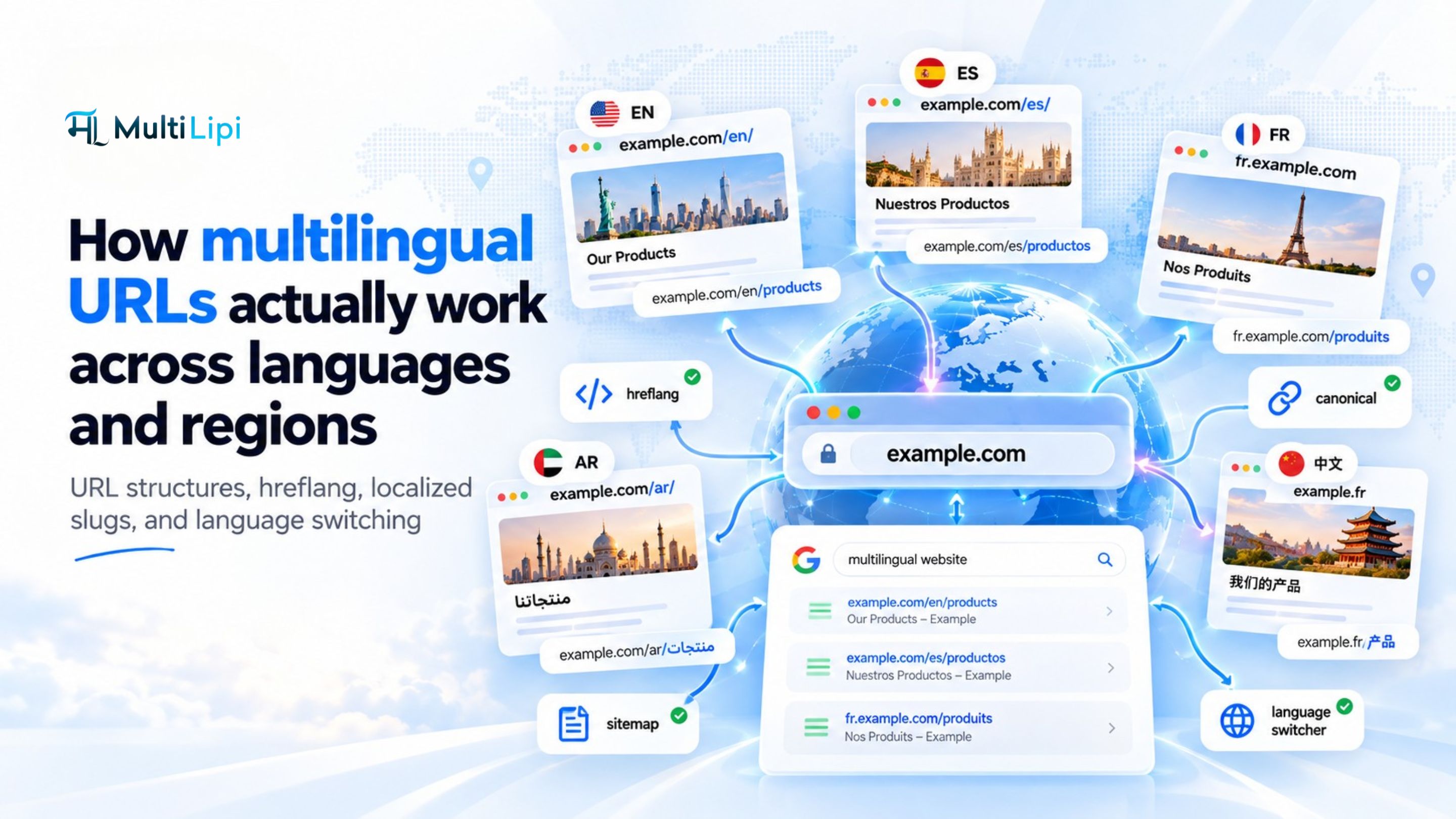
- Hreflang Automation: The platform automatically injects hreflang tags into the HTTP header or HTML head. These tags signal to Google exactly which language and region a page is intended for (e.g., es-MX for Spanish in Mexico vs. es-ES for Spain), preventing duplicate content issues and ensuring the right user sees the right page. For a deep dive, see (https://multilipi.com/blog/article/hreflang-tag-seo-guide).
- Server-Side Pre-Rendering: Unlike many plugins that use client-side overlays, MultiLipi ensures that the translated content is delivered in the source code. This means search engine bots can crawl and index the translated text just as easily as the original, a crucial factor for ranking.
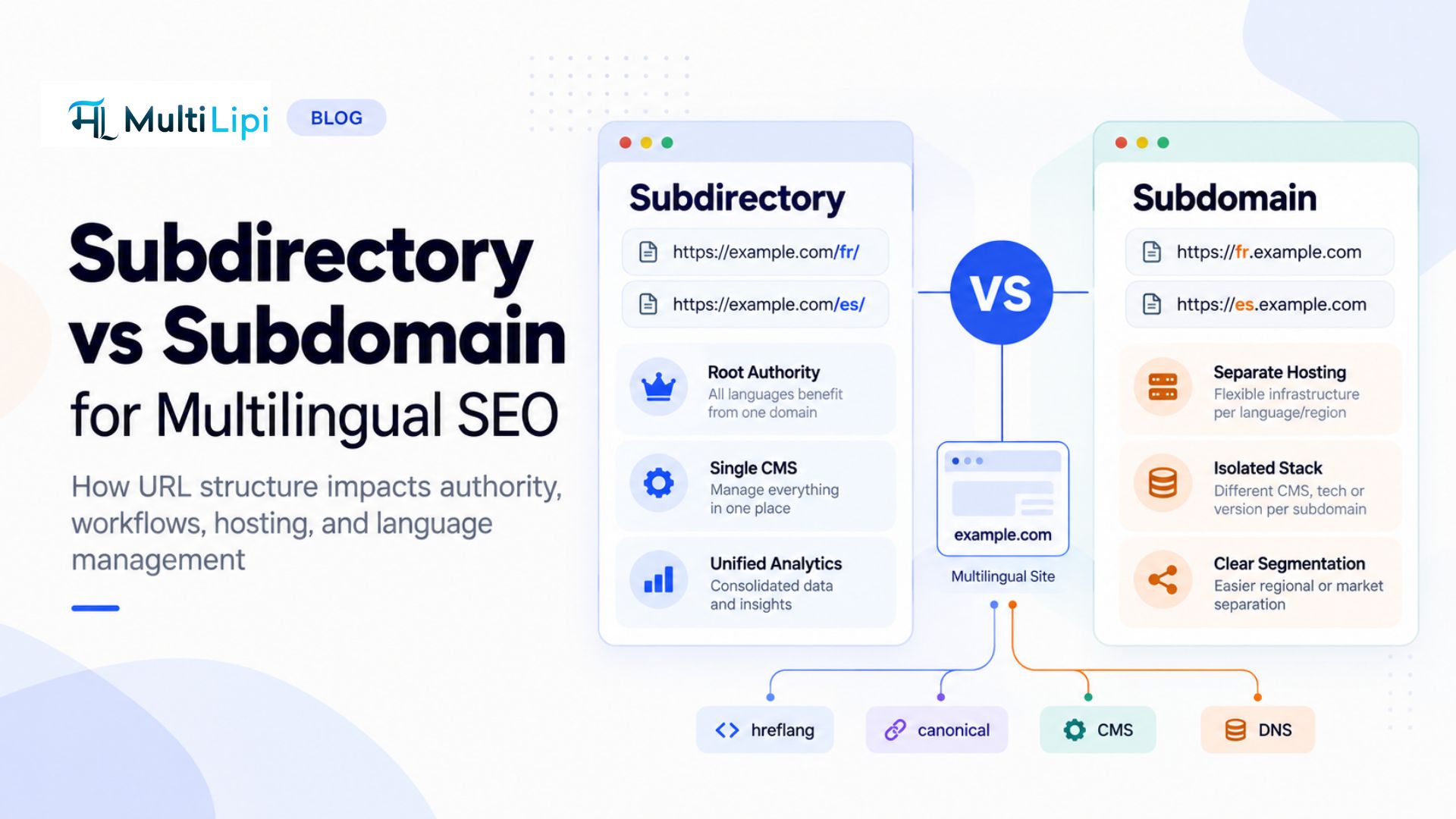
- URL Structure: It supports both subdirectories (e.g., example.com/fr/) and subdomains (fr.example.com), allowing businesses to choose the structure that best fits their domain authority strategy.
5.3 Keyword Localization Strategy
A critical component of the human layer in the hybrid model is International Keyword Research. AI translates words; humans translate intent.
- Example: An AI might translate "Cheap flights" into French as "Vols bon marché" (technically correct). However, a human editor knows that French users search for "Vols pas chers" 10x more frequently.
- Strategy: In the MultiLipi Visual Editor, the human editor swaps the AI's "Vols bon marché" for the high-volume keyword "Vols pas chers." This small human intervention can double organic traffic without changing the underlying meaning.
This capability is central to the strategies outlined in (https://multilipi.com/blog/article/international-seo-strategy). It allows marketing teams to optimize metadata (titles and descriptions) for local search intent, ensuring high Click-Through Rates (CTR) in foreign markets.
Chapter 6: Deep Dive: Implementing the Hybrid Workflow
6.1 The 80/20 Implementation Rule
Implementing the hybrid model successfully requires a strategic application of the Pareto Principle. Not all content deserves the same level of human attention.
The Localization Tiering Strategy follows a three-tier approach to maximize ROI using the 80/20 implementation rule. Tier 1: Hero Content includes high-impact pages such as the homepage, pricing pages, landing pages, checkout flows, and legal content, which are handled with AI plus full human review (transcreation) and require high human effort due to their direct impact on revenue and trust. Tier 2: Hub Content covers high-traffic blogs, product categories, and support center pages, where AI with light human review (MTPE) is applied, demanding a medium level of human effort to balance quality and scale. Tier 3: Hygiene Content consists of archived news, user reviews, footer content, and long-tail product pages, which are processed using AI-only raw translation with low to no human effort, enabling fast scalability. This tiered hybrid workflow ensures that 80% of the localization budget is focused on the 20% of content that drives the most revenue, delivering maximum efficiency and return on investment.
This strategy ensures that 80% of the budget is spent on the 20% of content that drives revenue, maximizing ROI.
6.2 Step-by-Step Implementation with MultiLipi
- Integration: Install the (https://wordpress.org/plugins/multilipi-multilingual-seo/) or JS snippet. This takes minutes and requires no coding.
- Configuration: Select target languages. Start with markets where you already see some traffic or where competitors are weak. Consult (https://multilipi.com/blog/article/identify-next-global-market-data-driven-guide) for data-driven selection.
- Glossary Setup: Before launching, input your brand terms into the MultiLipi Glossary (e.g., Product names, specific industry jargon). This "trains" the AI to respect your terminology from day one.
- Auto-Translation: Let the AI translate the entire site. It is now live and indexable.
- The Review Phase: Invite native speakers (employees, partners, or freelance linguists) to review Tier 1 content using the Visual Editor. Focus on tone, conversion elements (Call-to-Action buttons), and SEO keywords.
- Continuous Optimization: Use the (https://dashboard.multilipi.com/) to monitor performance. If a specific blog post starts getting traffic in Germany, upgrade it from Tier 3 to Tier 2 and assign a human editor to polish it.
6.3 Managing the Human Element
The shift to hybrid requires "Change Management." Translators may initially resist post-editing, viewing it as "cleaning up" after a machine. It is crucial to frame their role as "Language Leads" or "Cultural Consultants." Their value is no longer in typing words but in ensuring cultural fit and brand integrity.
Tools like MultiLipi facilitate this by making the editing process visual and intuitive, removing the technical friction that frustrates linguists in traditional workflows.
Chapter 7: Industry-Specific Applications
7.1 E-Commerce: Scale and Speed
For e-commerce, the catalog size is the enemy. A fashion retailer with 10,000 SKUs cannot afford human translation for every product description.
- Hybrid Application: Use AI for the 10,000 product descriptions. Use Humans for the Homepage, "About Us," and the Checkout flow.
- Result: The entire store is indexable (Long-tail SEO), but the trust-building pages are perfect.
- Resource: (https://multilipi.com/blog/article/ecommerce-guide-to-going-global-7-steps).
7.2 SaaS: Technical Accuracy
SaaS products have complex UIs and extensive documentation.
- Hybrid Application: Use Glossary rules in MultiLipi to ensure UI terms like "Dashboard," "Settings," and "Analytics" are consistent. Use human editors to review the onboarding flow to ensure instructions are clear and the UI doesn't break due to text expansion.
- Result: Reduced customer support tickets and higher activation rates in non-English markets.
- Resource: (https://multilipi.com/blog/article/saas-global-scaling-multilingual-content-strategy).
7.3 Travel and Hospitality: Emotional Resonance
Travel is about selling a dream. "Cozy room" is a translation; "An intimate sanctuary" is a transcreation.
- Hybrid Application: AI handles the booking engine functionality (dates, prices). Humans rewrite the hotel descriptions and destination guides to evoke emotion and desire.
- Result: Higher booking conversion rates.
- Resource: (https://multilipi.com/blog/article/cultural-design-global-audience).
Chapter 8: Future Trends: The Post-Localization Era
8.1 From "Translation" to "Generation"
The future of the hybrid model lies in Generative AI. Instead of translating English to Spanish, future iterations of tools like MultiLipi may regenerate the content based on the prompt "Write this product description for a Mexican audience." This blurs the line between translation and copywriting, offering even higher relevance.
8.2 Agentic AI in Localization
We are moving toward "Agentic AI"—systems that don't just wait for commands but act autonomously. An AI agent might notice that your "Pricing" page has a high bounce rate in Japan, hypothesize that the tone is too direct, rewrite it to be more polite (a cultural norm in Japan), and present the A/B test results to the human manager.
8.3 Voice and Video: The Next Frontier
As bandwidth increases, the web is moving from text to video. The hybrid model is expanding into AI dubbing and voice translation. MultiLipi is positioned to integrate these modalities, allowing brands to localize not just their website text but their embedded video content, creating a fully immersive localized experience.
Conclusion: The New Standard for Global Business
The debate between "Human" and "Machine" is obsolete. The data is clear: pure human translation is too slow for the content explosion, and pure machine translation is too risky for brand integrity. The Hybrid Translation Model is the synthesis that resolves this dialectic.
By adopting a hybrid approach powered by platforms like MultiLipi, businesses can:
- Scale Infinitely: Launching in 100 languages is as easy as launching in one.
- Move Instantly: Content is live the moment it is created.
- Optimize Continuously: Human expertise is focused on value, not volume.
- Grow Exponentially: Multilingual SEO opens up new markets that were previously invisible.
In an increasingly fragmented and competitive global market, the ability to speak the customer's language is the ultimate competitive advantage. The hybrid model makes this advantage accessible to everyone. It is not just a translation strategy; it is a growth engine for the modern enterprise.

Comments