The Silent Killer of Brand Reputation
Right now, AI systems are confidently stating false information about your company to millions of users—and you probably don't even know it's happening.
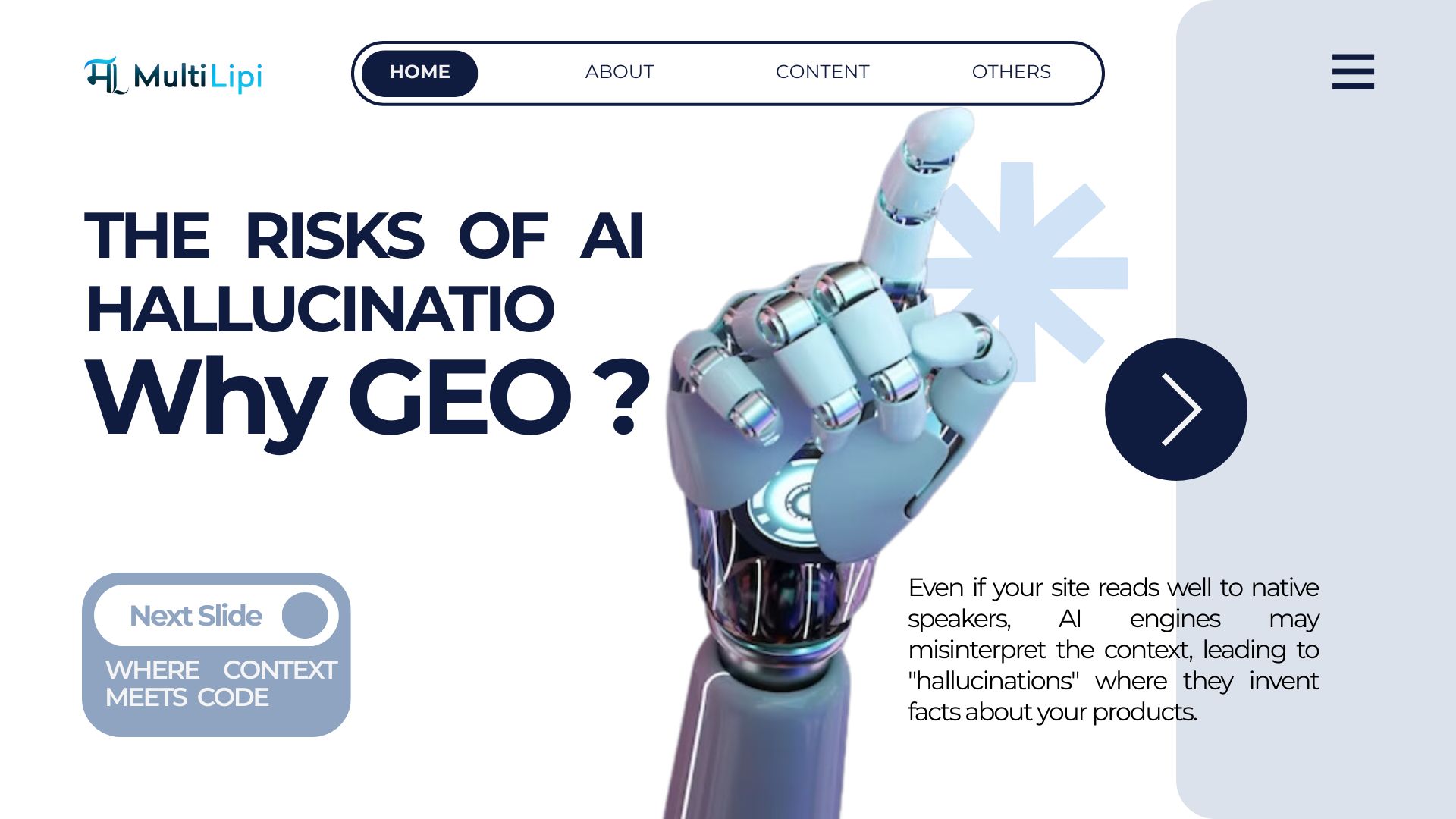
When ChatGPT, Perplexity, or Google's AI Overviews attempt to answer questions about your brand, products, or services, they sometimes generate completely fabricated information. These "hallucinations" appear authoritative and well-written, making them particularly dangerous. Users trust AI answers implicitly, meaning false information spreads as truth.
For multilingual websites, the problem is exponentially worse. Poor translation quality, inconsistent entity naming, and structural issues across language versions create the perfect conditions for AI to misinterpret, conflate, and hallucinate information about your brand. The damage is silent, pervasive, and incredibly difficult to detect—until it's too late.
What Are AI Hallucinations?
In AI terminology, a "hallucination" occurs when a language model generates information that is plausible-sounding but factually incorrect, fabricated, or contradictory to source material. Unlike traditional search errors where you might get an irrelevant link, AI hallucinations present false information as confident, authoritative truth.
Types of Hallucinations That Damage Brands
AI hallucinations affecting brands typically fall into several categories:
- Factual Fabrication: AI invents features, products, or capabilities your company doesn't have
- Pricing Errors: Incorrect pricing, subscription terms, or availability claims
- Capability Misrepresentation: Overstating or understating what your product can do
- Entity Confusion: Conflating your brand with competitors or unrelated companies
- Geographic Errors: Claiming you operate in markets you don't serve or vice versa
- Historical Inaccuracies: Wrong founding dates, leadership, company milestones
The insidious part is how confident these hallucinations appear. AI doesn't say "I'm not sure" or "this might be incorrect"—it states fabrications with the same authoritative tone as verified facts. Users have no way to distinguish truth from hallucination without manual fact-checking.
⚠️Real Example
A B2B SaaS company discovered that ChatGPT was confidently stating they offered a "free tier for up to 100 users"—a product tier that never existed. Prospective customers arriving via AI search expected this non-existent offering, creating confusion and damaging sales conversations.
The root cause? Poor translation quality in their German pricing page that AI misinterpreted as describing a free tier.
Why Multilingual Sites Are Particularly Vulnerable
Multilingual websites face a perfect storm of factors that dramatically increase AI hallucination risk. While English-only sites certainly experience hallucinations, the complexity of managing content across multiple languages creates numerous additional failure points.
Hallucination Risk: Monolingual vs. Multilingual
Well-Structured English Site
Poorly Managed Multilingual Site
Five Vulnerability Factors
1. Translation Quality Issues
Poor machine translation or low-quality human translation introduces errors that AI interprets as facts. A mistranslated feature description in French becomes "evidence" that your product has capabilities it doesn't. AI doesn't understand translation errors—it treats all text as intentional truth.
2. Inconsistent Entity Naming
When your product is called "CloudSync Pro" in English, "CloudSync Professionell" in German, and "Professionale CloudSync" in Italian, AI may treat these as three different products. This entity fragmentation creates confusion and enables AI to fabricate distinctions between these "different" offerings.
3. Schema Markup Inconsistency
If your English site has proper schema markup but your Spanish site doesn't, AI receives contradictory structural signals. This inconsistency increases hallucination risk as AI attempts to reconcile conflicting information sources.
4. Cultural Localization Errors
Well-intentioned localization that adapts product names or descriptions for cultural relevance can backfire. AI may interpret cultural adaptations as describing different products or features, leading to hallucinated distinctions that don't exist.
5. Outdated Translations
When you update English content but translations lag behind, AI encounters contradictory information across languages. Old pricing in German, new pricing in English, partially updated French—AI synthesizes this into completely fabricated hybrid information.
Real-World Damage from AI Hallucinations
The business impact of AI hallucinations extends far beyond theoretical concerns. Companies are experiencing tangible damage from false AI-generated information about their brands.
Revenue and Sales Impact
When AI hallucinates features, pricing, or capabilities, it creates false expectations that damage sales conversations. Prospective customers arrive expecting offerings that don't exist, leading to confusion, frustration, and lost deals. Sales teams waste time correcting AI-generated misinformation rather than closing business.
Even more insidious: AI might understate your capabilities, causing you to lose deals you should have won. If ChatGPT tells a buyer your product doesn't support integration with Salesforce when it actually does, you never even get the opportunity to compete.
Brand Reputation Damage
AI hallucinations can damage brand reputation in ways that are difficult to measure but easy to feel. When AI states false negative information—security vulnerabilities that don't exist, compliance failures that never happened, customer complaints that are fabricated—it creates doubt and distrust that persists even after correction.
The challenge is detection. Traditional brand monitoring catches social media mentions and news coverage, but AI hallucinations happen in private conversations between users and AI systems. You have no visibility into how many potential customers received false information about your brand.
⚠️Case Study: Enterprise Software Company
An enterprise software company discovered AI was hallucinating that their product required on-premise installation—directly contradicting their cloud-first positioning. The source? A poorly translated German FAQ that machine translation rendered as describing on-premise deployment.
Impact: Estimated $2.3M in lost cloud subscription revenue over 6 months before detection. Countless sales conversations derailed by prospects insisting "AI said it requires on-premise installation."
Prevention Strategies: Building Hallucination-Resistant Content
While you can't completely eliminate AI hallucination risk, you can dramatically reduce it through strategic content structure and multilingual management practices.
Entity Consistency
Maintain identical brand names, product names, and key terminology across ALL languages. Never translate brand entities.
Translation Quality
Invest in high-quality translation with expert review. Poor translations are hallucination generators.
Schema Markup
Implement consistent schema markup across all language versions to provide clear entity signals to AI.
Content Synchronization
Keep all language versions updated simultaneously. Outdated translations create conflicting "facts" for AI.
Technical Implementation Checklist
Implementation Checklist
The goal is to make your content so clear, consistent, and well-structured that AI systems have no ambiguity to resolve—and therefore no opportunity to hallucinate. When all your language versions tell the same factual story with consistent entities and structured data, AI can accurately represent your brand.
Detection and Monitoring
Prevention is ideal, but you also need detection mechanisms to identify when AI systems are hallucinating about your brand despite your best efforts.
Monitoring Strategies
- Regular AI Audits: Systematically query ChatGPT, Perplexity, Google AI Overviews, and other systems with questions about your brand, products, and services. Document responses and identify hallucinations.
- Multi-Language Testing: Perform AI audits in all your target languages. Hallucinations often vary by language due to translation quality differences.
- Customer Feedback Analysis: Track customer questions and misconceptions. Patterns of confusion often indicate upstream AI hallucinations.
- Sales Team Intelligence: Your sales team encounters AI-generated misinformation firsthand. Create feedback loops to capture and address hallucinations they discover.
✅MultiLipi Protection
MultiLipi's platform is specifically designed to prevent AI hallucinations on multilingual sites:
- Enforces entity consistency across all 120+ languages
- Ensures translation quality through hybrid AI + human expert review
- Automatically maintains schema markup consistency
- Synchronizes content updates across all language versions simultaneously
- Provides AI hallucination monitoring as part of the platform
Protecting Your Brand in the AI Era
AI hallucinations represent a new category of brand risk that most companies are only beginning to understand. For multilingual websites, the risk is substantially higher due to translation complexity, entity inconsistency, and structural challenges across language versions.
The good news is that hallucination risk is manageable through strategic content structure, high-quality translation, entity consistency, and proper technical implementation. Companies that take AI hallucination seriously and implement prevention strategies will protect their brand reputation while competitors suffer silent damage.
The question isn't whether AI will hallucinate about your brand—it will. The question is whether those hallucinations will be minor and rare, or pervasive and damaging. Your multilingual content strategy determines the answer. Start by auditing your site with our free SEO Analyzer and ensure proper schema implementation with our Schema Validator.